Who will pay for an anti-aging drug?
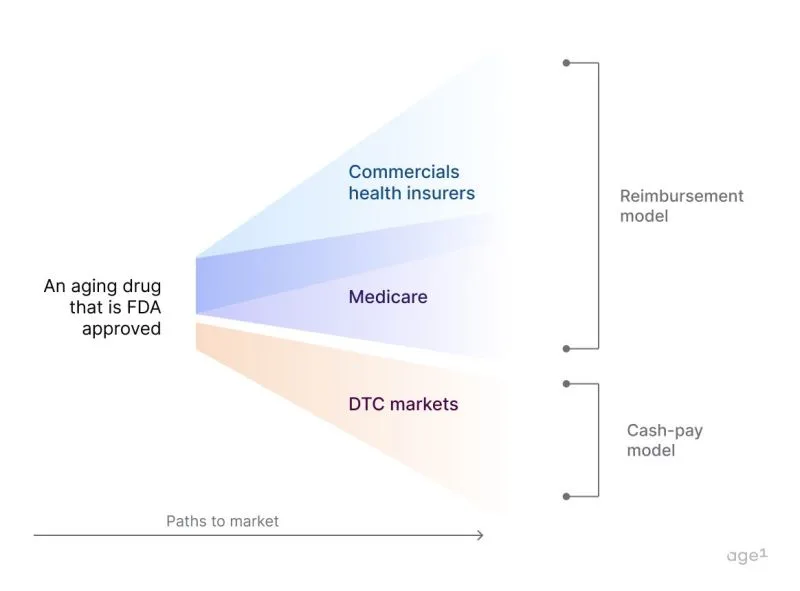
In a thought-provoking blog post a little more than 2 years ago ($200 Billion in Revenue: How an Aging Drug Will Conquer Pharma, lnkd.in/gfzS3dax), age1's Alex Kesin, Maggie Li and Alex Colville wondered who will pay for an aging drug and offered this illustration of possible paths to market (payment/reimbursement) for an aging drug that is approved by the FDA. They were a bit off re: GLP-1 as total sales in 2025 are estimated to be around $50bn-$60bn, with Eli Lilly and Company expected to reach $45bn in GLP-1 sales in 2026! Given the likely (but not yet proven) impact of GLP-1 medicines on diseases of aging, the authors' estimates were definitely not crazy!
But back to who will pay for this, especially in the US, there is another candidate that may sound strange but makes a lot of sense: life insurers (listen to John Hancock's Brooks Tingle's conversation with Jordan Shlain, MD at DOC 2025: lnkd.in/gKrPNF8h). Obviously, life insurance is not a universal solution and is not available or accessible to all, but the incentives of a life insurer are much better aligned with the patient's interests than any current US health insurer (other than CMS). For life insurers, eternal life (ok, extreme longevity) of a member paying annuities is the holy grail.