Blocking low-grade inflammation will create the new Lipitor(s)
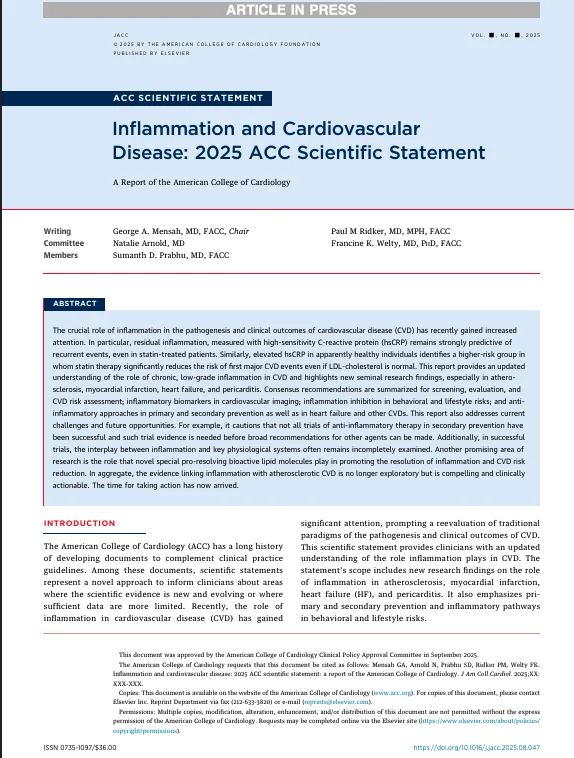
This timely report (in press) of the American College of Cardiology summarizes evidence and recommendations around Cardiovascular (CV) disease and (chronic, systemic, low-grade) inflammation (CLGI). The authors argue that “the evidence linking inflammation with atherosclerotic CVD is no longer exploratory but is compelling and clinically actionable.” For example, one of the authors, Paul Ridker of Harvard University Brigham and Women's Hospital has led research that found that:
1️⃣ “downstream biomarkers of inflammation such as high sensitivity C-reactive protein (CRP) and interleukin-6 (IL-6beta) are associated with an increased risk of CV events, independent of the cholesterol level” (Ridker P. M. et al. (2000) N Engl J Med 342, 836-43.),
2️⃣ “statins reduce the levels of cholesterol and markers of inflammation [...] and beneficial outcomes after statin therapy relate to both a reduction in cholesterol level and inflammation inhibition” (Ridker P. M., et al. (2005) C-reactive protein levels and outcomes after statin therapy. N Engl J Med 352, 20-28.),
3️⃣ “anti-inflammatory therapy targeting the IL-1β innate immunity pathway with canakinumab at a dose of 150 mg every 3 months led to a significantly lower rate of recurrent cardiovascular events than placebo, independent of lipid-level lowering” (Ridker, P. M. et al. (2017) Antiinflammatory Therapy with Canakinumab for Atherosclerotic Disease. N Engl J Med 377,1119-1131).
In other words, one of the biggest successes of the pharmaceutical industry, statins, may reduce CV events by reducing inflammation as much as by reducing LDL (which they definitely do). Making LDL levels a compelling biomarker and packaging “high cholesterol” as a disease has made the broad use of statins possible. Lipitor was the best-selling drug of all time by lifetime revenue, topping $150 billion over decades, before being supplanted by... anti-inflammatory Humira in 2023.
Creating a similarly compelling, perhaps aggregate, biomarker of inflammation beyond hs-CRP and labeling CLGI a disease may lead to drugs that target CLGI directly with even broader benefits than statins. In fact, statins may be part of the CLGI-blocking arsenal. So may GLP-1 RA drugs. But there are other actionable points of leverage that focus on the upstream causes of CLGI. These will lead to the new Lipitor(s).
Eric Topol, Jordan Shlain, John Battelle, David Barzilai, Jessica Schumer, Dave Ricks, Richard Barker, Brooks Leitner, Elliot Hershberg, Phil Newman, Alex Colville