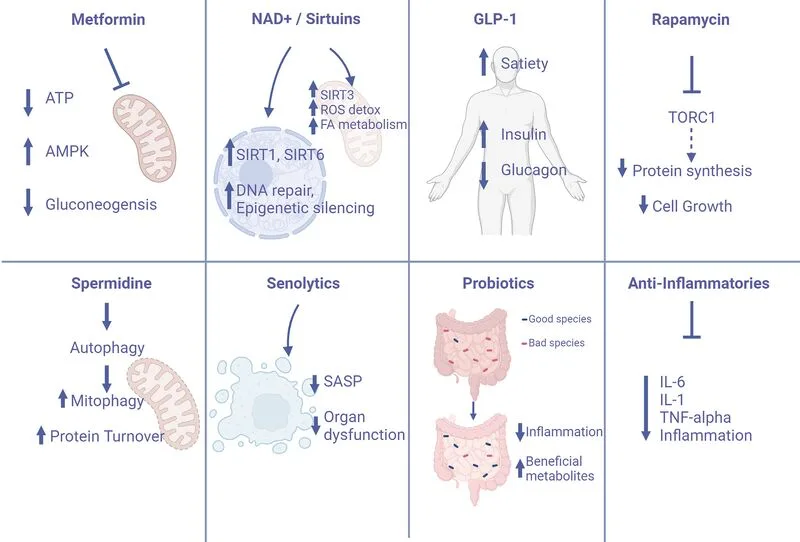
8 interventions in human trials for diseases of aging
Very useful review Leonard Guarente (Massachusetts Institute of Technology), David A Sinclair (Harvard Medical School) and Guido KROEMER (INSERM) under the banner of Academy for Health & Lifespan Research.
There is obviously a lot more going on in healthspan and aging research but this review includes a lot of different categories: hashtag#senolytics, hashtag#probiotics and hashtag#antiinflammatories cover a lot of existing research. Given the explosion of studies in this field, there should be a lot more in the near future.
Figure legend:
"Metformin, a drug to treat diabetes, may work by a mechanism involving inhibition of complex I of the mitochondrial electron transport chain, leading to a
reduction of ATP levels, activation of AMP-activated protein kinase (AMPK) and a repression of gluconeogenesis in the liver. NAD+ precursors restore youthful
NAD+ levels in cells, thus activating nuclear and mitochondrial sirtuins to promote DNA repair and epigenetic silencing in the nucleus and detoxification of reactive oxygen species (ROS) and fatty acid (FA) catabolism in mitochondria. Youthful NAD+ levels will also foster activity of poly(ADP-ribose) polymerase (PARP) and several metabolic enzymes. GLP-1R agonists activate insulin production and glucagon repression in liver and the food satiety response in the hypothalamus (H). Rapamycin represses activity of TORC1 and thus protein synthesis and cell growth. Spermidine promotes autophagy, which turns over damaged mitochondria as well as denatured proteins. Senolytics kill senescent cells and thus blunt the senescence-activated secretory response (SASP), which can trigger organ dysfunction. Probiotics enhance the growth of beneficial bacterial species in the gut at the expense of toxic species. Anti-inflammatories blunt the activities of pro-inflammatory cytokines, which are a part of the adaptive immune response, and thus reduce systemic inflammation."