VO2 max and Inflammation
As Brooks Leitner reminds us (https://lnkd.in/g7J7mCDv), VO2max, a measure of cardiorespiratory fitness, is also a strong independent predictor of all-cause mortality.
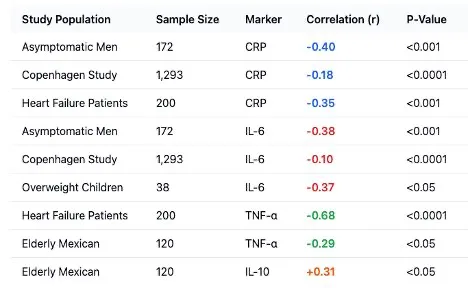
Of course I wanted to explore possible correlations 📉 between serum markers of inflammation and VO2max and I did find a number of interesting studies that show statistically significant correlations. The causal nature of the relationship can of course not be inferred from these studies but in another post I will make the case that low-grade chronic inflammation is indeed one cause of VO2max reduction. So here are five studies I found and summarized into a table.
· All studies used validated, reproducible methods for both fitness and inflammatory marker assessment
· Inter- and intra-assay coefficients of variation typically <10%
· Appropriate statistical power calculations and significance levels
· Comprehensive exclusion criteria to minimize confounding variables
The conclusion: These five studies represent the foundational evidence base for understanding VO2 Max and inflammatory marker relationships across the lifespan and health spectrum, from pediatric populations to elderly adults, and from healthy individuals to those with clinical heart failure. Clinical populations generally show stronger correlations than healthy individuals. Exercise interventions report 10-15% VO2 Max improvements correlating with 15-41% reductions in inflammatory markers. The Mexican study also shows a positive correlation with the anti-inflammatory molecule IL-10.
• Asymptomatic Men Study: Church TS, Barlow CE, Earnest CP, Kampert JB, Priest EL, Blair SN. Associations between cardiorespiratory fitness and C-reactive protein in men. Arteriosclerosis, Thrombosis, and Vascular Biology. 2002;22(11):1869-1876.
• Copenhagen Study: (50 yr old men and women): Wedell-Neergaard AS, Lang Lehrskov L, Christensen RH, et al. Exercise-induced changes in visceral adipose tissue mass are regulated by IL-6 signaling: a randomized controlled trial. Cell Metabolism. 2019;29(4):844-855.e3.
• Heart Failure Patients Study: Haykowsky MJ, Tomczak CR, Scott JM, Paterson DI, Kitzman DW. Determinants of exercise intolerance in patients with heart failure and reduced or preserved ejection fraction. Journal of Applied Physiology. 2015;119(6):739-744.
• Overweight Children Study: Bodner-Leidecker A, Ehrhart-Bornstein M, Eisenhofer G, et al. Negative correlation between serum IL-6 level and cardiorespiratory fitness in 10- to 11-year-old boys with increased BMI. Journal of Pediatric Endocrinology and Metabolism. 2013;26(5-6):419-424.
• Elderly Mexican Study: Martínez-Gómez D, Eisenmann JC, Wärnberg J, et al. Relationship between aerobic capacity with oxidative stress and inflammation biomarkers in the blood of older Mexican urban-dwelling population. Frontiers in Aging Neuroscience. 2018;10:98.