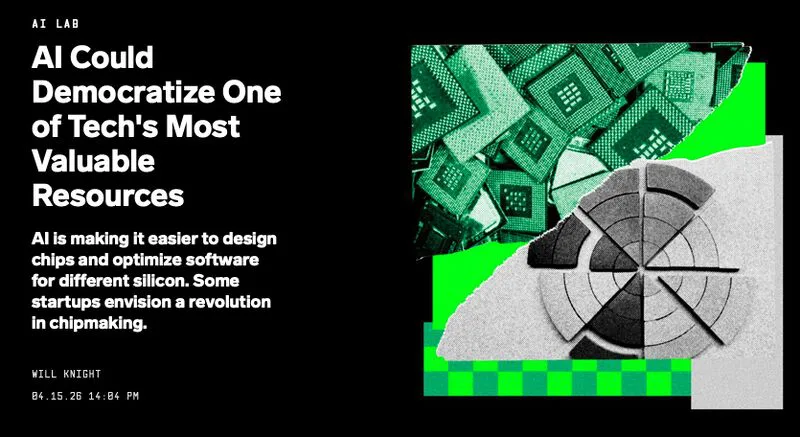
A short article by WIRED's Will Knight may be one
A short article by WIRED's Will Knight may be one of the most important pieces anyone interested in AI needs to read right now (sadly behind a paywall, so I'll try to distill its essence). Although it focuses on Emilio Andere's Wafer, it describes a movement, stemming partly from an urge to move away from Nvidia's grip on AI chips and also from a natural drive toward code optimization to run efficiently on any specific chip. One may be forgiven for thinking that Nvidia's competitive advantage was all about hardware but it has always been the combination of hardware and software, particularly the famed CUDA.
www.wired.com/story/ai-could-democratize-one-o… ☠️ The first obvious threat to that dominance made a big splash in late 2024/early 2025: for its V3 and R1 models, DeepSeek achieved a breakthrough by bypassing NVIDIA's CUDA software and rewriting core components to use lower-level Nvidia PTX (Parallel Thread Execution) assembly programming. This allowed them to optimize their models for higher efficiency on constrained hardware (specifically the H800 GPU, a throttled chip for the Chinese market) to achieve performance comparable to larger, more expensive models, often showing up to 10x higher efficiency than peers. The resulting market cap loss for NVIDIA was immediate, if not long lasting. ➡️ Since then a number of competitors have found opportunities to boost the performance of their chips by optimizing the code that runs of them. With AI now being able to write complex code, it has become possible for chip companies and for companies with their own in-house chips (e.g., Google, Amazon, Apple) to optimize performance on their own processors, approaching (according to Andere) the "same theoretical flops as Nvidia GPUs". Wafer is helping these companies achieve these levels of "intelligence per watt." ➡️ Using a different approach, Naveen Rao's Unconventional AI is designing chips and algorithms together, or, to use one of my favorite expressions, "co-evolving them" to have the perfect mutual match. Different algorithms may require different architectures and communications, which adds an interesting layer of complexity. Given Naveen's track record, if anyone can pull it off it is him. I will end with the most consequential observation made by Andere: so far, "the moat lives in the programmability of the chip,” (i.e., tools for optimizing code for Nvidia hardware). “I think it's time to start rethinking whether that's actually a strong moat.” Nvidia is not exactly a weakling, but its economic rent may erode faster than most people think.