Why Programming Was Never About Code
“I think there is a world market for maybe five computers.”
— Thomas Watson, 1943, showing more restraint than npm package authors
In lieu of my favorite cartoons, I will be sharing a sequence of spot-on, hilarious and yet somewhat deep and tragic statements about code by one mysterious Krzyś Guttenbergovitz. His post from November 2025 (The Eternal Return of Abstraction: Why Programming Was Never About Code) contains so many gems that they have to be distilled. My first choice is about linguistic reduction.
"We took natural language — with all its poetry, ambiguity, metaphor, and ability to say “it depends” — and we deliberately amputated it. Like Victorian surgeons, but with less anesthesia and more semicolons.
FORTRAN (1957): We can’t handle “approximately” or “probably,” so everything becomes exact. Feelings are banned. Nuance is punishable by compilation error.
COBOL (1959): We try to look like English but strip out all the interesting parts. Like Shakespeare rewritten by accountants. “PERFORM CALCULATE-INTEREST UNTIL HELL-FREEZES-OVER.”
C (1972): Forget looking like English. Embrace the brackets. Worship the pointer. Segmentation fault is a way of life.
Java (1995): Add ceremony. More ceremony. Classes for everything. AbstractSingletonProxyFactoryBean isn’t a joke, it’s a real Spring class. God is dead and we have killed him with XML configuration.
Python (1991): Pretend simplicity while hiding complexity. “Executable pseudocode,” they said. “It’ll be fun,” they said. Now we have the GIL and nobody’s having fun (yeah... I know, we’re working on getting rid of GIL and we have even invented Mojo recently, but still...).
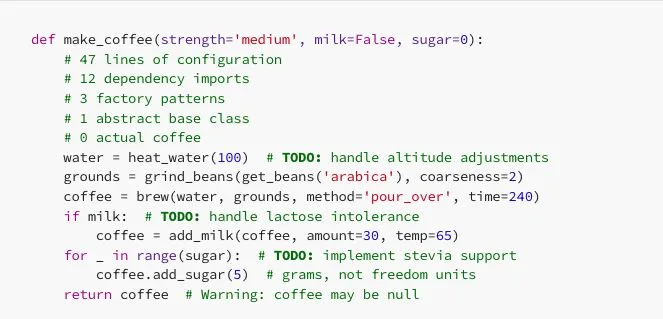
Each iteration was a negotiation: how much humanity do we sacrifice for determinism? How much expression do we surrender for precision? Turns out: all of it. We surrendered all of it. We spent forty years teaching ourselves to think like machines. We learned to decompose “make me a coffee” into:"