Change in P(ts) per US$
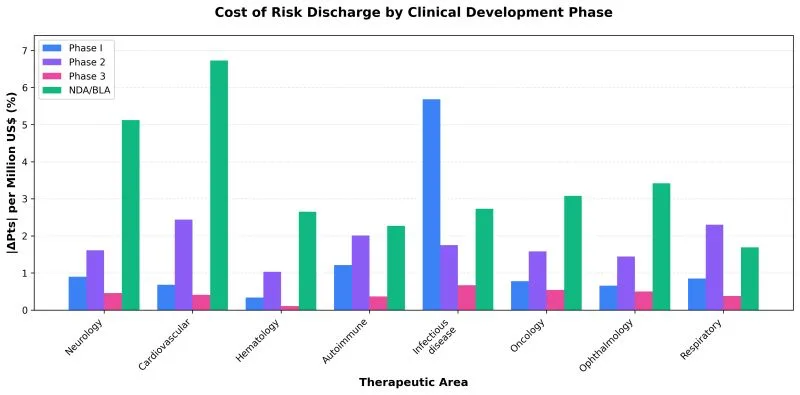
Here is how much increase in P(ts) you get by spending one million US$ in clinical phases and regulatory for 8 therapeutic areas (TAs). This is obviously averaged over many data points (ASPE Drug Development analysis, 2024 update; Sertkaya et al., 2016/2024) and only directionally valid. Viewed purely from a P(ts) increase perspective (or "risk discharge" for a casual definition of risk), it is clear that:
1️⃣ Phases I and II are much more efficient at increasing P(ts) than Phase III. That makes sense: Phase III is confirmatory and is required, an obvious but important point as its main function is not to increase confidence in the technical merits of an asset.
2️⃣ A natural consequence of this observation is that R&D organizations should focus on resolving uncertainly around the technical merits of an asset and design studies accordingly in Phases I and II (up to POC) and pivot to a "let's not rock the boat and just confirm" mindset for Phase III, preparing for success and launch. In 2008, we coined the term "success-seeking" vs "truth-seeking" in our Harvard Business Review article on Eli Lilly's Chorus.
3️⃣ Some TAs see a significant increase in P(ts) in the regulatory filing phase, which is not as expensive as the other phases, thereby making it super-efficient at risk discharge. It is somewhat of an artifact but it highlights the risk remaining for some TAs more than others in the last mile.
4️⃣ Infectious diseases are in a different world.
Simon Birksø Larsen, Ibrahim Mian, MD
Thank you for this Ibrahim Mian, MD! Delta(P_ts) is definitely the best measure of phase effectiveness: it quantifies how much risk has been discharged, it should be used more often. And Delta(P_ts)/[CostxTime] is a measure of phase efficiency. I would go as far as to argue that |Delta(P_ts)| (the absolute value) is the right measure from an organizational perspective. But that's for another comment or post. To clarify, Pts as it is usually defined is a (frequentist) portfolio-level metric that requires lots of WIPs to estimate, so ΔPts better be positive (in the aggregate, LOA needs to go up with phase progression or the business is doomed!). But a lot of folks, including myself, use the concept of Pts at the WIP level in a more Bayesian way with the objective of maximizing the distance between prior and posterior; that can be used as an organizational framework to promote fast and cheap ∣ΔPts∣.
As Peter Drucker once said in an interview, "many decisions are ultimately made by the hydrostatic pressure in the boss's bladder". The default approach has often been to ignore the complexities and use intuition or "business instinct". But in the age of AI, it might be possible to combine both.