Will all our drugs come from China?
That's the title of an insightful blog post (lnkd.in/g43rMTWN) from Alex Telford.
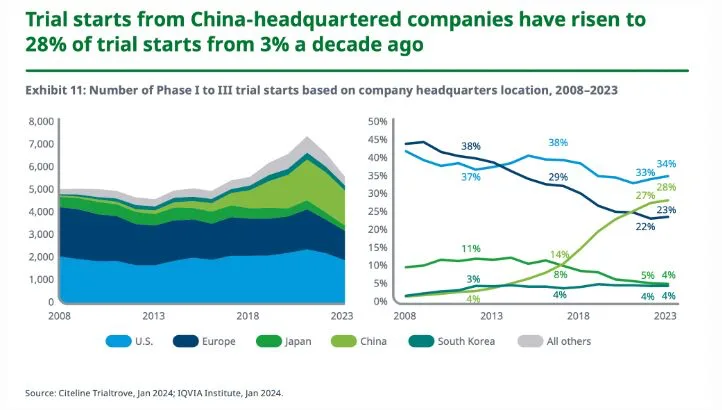
China's pharmaceutical industry has evolved from primarily manufacturing active pharmaceutical ingredients (APIs) to becoming a significant source of novel drug innovations. Chinese companies now initiate about a quarter of new clinical trials globally, surpassing Europe, with notable activity in early-stage oncology and cell and gene therapies. Alex provides a list of factors that made that happen -investment, return of US-based Chinese scientists, regulatory reforms (87 days to IND!).
We are all very curious, and somewhat anxious, to see how the US will respond, whether the BioSecure Act (which would prevent Federal agencies from doing business with a number of Chinese biopharma service companies, WuXi AppTec and WuXi Biologics among them) will pass the Senate and how the biotech ecosystem will evolve in this new context.
Now, one thing is clear, if Chinese biotechs continue to produce more high-quality, cost-effective innovation, "the big losers are unlikely to be the big Western pharmas (after all, they’re getting good molecules for cheap), but rather the innovator ecosystem of Western startups and clinical-stage biotechs that have traditionally fed the pipelines of the pharma giants. Licensing deals are a major source of revenue that biotechs use to fund operations and research, revenue that is now being redirected to China. The European biotech scene, already fading in relevance (partly due to a weak local market following aggressive pricing constraints), might drop off entirely."
The irony should not be lost on US patients: the high prices we are paying (willing to pay?, able to pay?) for drugs are ensuring the US Pharma industry's dominance as the late-stage gatekeepers to the most profitable drug market in the world. The game may become even more profitable for them.
As for the biotech innovation ecosystem (everywhere), there has to be a sweet spot and it likely involves being able to plug-and-play/orchestrate discovery and early development with CROs and partners worldwide, especially China.
It is also quite possible that member countries of The Cooperation Council for the Arab States of the Gulf (GCC) will become a major biotech innovation hub that will disrupt this somewhat binary picture.