Evolution is Accelerating
As a 30-year groupie of evolutionary computation, I am particularly sensitive to this trend: evolutionary AI is on the rise. The latest case in point, of course is @google deepmind’s AlphaEvolve, which uses LLMs to automate the construction of evolutionary operators (in this case, mutations, which do not have to be defined ahead of time) to create new programs to solve mathematical programs.
Geoffrey Miller, Peter Todd and Shailesh Hedge’s paper (https://www.researchgate.net/profile/Geoffrey-Miller-5/publication/220885651_Designing_Neural_Networks_using_Genetic_Algorithms), Hiroaki Kitano’s GA with graph generation (content.wolfram.com/sites/13/2018/02/04-4-6.pdf), Dave Chalmers’ 1990 paper on “genetic connectionism” (lnkd.in/grTpYf3w), Dario Floreano’s and Francesco Mondada’s neuroevolution (lnkd.in/gVqaAPJc), Riccardo Poli’s 1998 topology and weights evolution (lnkd.in/gRAgphpn), Kenneth Stanley’s and Risto Miikkulainen 2002 NeuroEvolution of Augmenting Topologies (NEAT) (lnkd.in/gUPYpwUH).
The application of evolutionary algorithms (EAs) to neural networks goes back to at least Dave Chalmers’ (yes, THAT David Chalmers! consc.net ) 1990 paper on “genetic connectionism” (published in 1991: https://consc.net/papers/evolution.pdf), @dario floreano’s and @francesco mondada’s neuroevolution (Evolution of Plastic Neurocontrollers for Situated Agents, www.research-collection.ethz.ch/bitstream/hand…), @riccardo poli’s 1998 topology and weights evolution (Pujol, J.C.F., Poli, R. Evolving the Topology and the Weights of Neural Networks Using a Dual Representation. Applied Intelligence 8, 73–84 (1998). https://doi.org/10.1023/A:1008272615525), @kenneth stanley’s and @risto mikkulainen’s NeuroEvolution of Augmenting Topologies (NEAT) (Evolving neural networks through augmenting topologies. Evol. Comput. 10, 99–127 (2002), https://doi.org/10.1162/106365602320169811).
Then not much happened for 10 or 15 years, until deep learning burst onto the scene and made it look like EAs had become obsolete. The fact that Generative Adversarial Networks (GANs), a super popular deep learning technique, look very similar in their principles to co-evolutionary (mini-max) games, did not change the perception, even though multiple groups have been using co-evolution techniques to improve and stabilize GANs. @openAI’s 2017 paper (imagine that, OpenAI in 2017!), Evolution Strategies as a Scalable Alternative to Reinforcement Learning (Tim Salimans, Jonathan Ho, Xi Chen, Szymon Sidor, Ilya Sutskever, https://arxiv.org/abs/1703.03864) was weirdly interesting article but it did not move the needle as it simply stated that you could do as well with EAs as another technique. With the resurgence of Reinforcement Learning, this odd paper may have found new meaning.
But in recent years we have seen an explosion of new ideas beyond evolving the weights (a mostly inefficient alternative to SGD) and architectures (but here is a good review of Evolutionary Neural Architecture Search: Y. Liu, Y. Sun, B. Xue, M. Zhang, G. G. Yen and K. C. Tan, "A Survey on Evolutionary Neural Architecture Search," in IEEE Transactions on Neural Networks and Learning Systems, vol. 34, no. 2, pp. 550-570, Feb. 2023, doi: 10.1109/TNNLS.2021.3100554, open access: arxiv.org/abs/2008.10937)). Attached to this post is an excellent early 2025 review categorizes the different approaches that have emerged, although it does not include the more recent AlphaEvolve: (Wang C, Zhao J, Jiao L, Li L, Liu F, Yang S. When Large Language Models Meet Evolutionary Algorithms: Potential Enhancements and Challenges. Research 2025; 8:Article 0646. https://doi.org/10.34133/research.0646).
In addition to AlphaEvolve, which offers an original use of LLMs and EAs, I would mention, with the arbitrary discretionary power writing a post gives me, the work of Sakana AI: Takuya Akiba, Makoto Shing, Yujin Tang, Qi Sun & David Ha (2024) Evolutionary optimization of model merging recipes (open access! https://www.nature.com/articles/s42256-024-00975-8): merging models in “data flow space” by combining inference paths from different models, very cool! I also find the AI Scientist work of @sakana AI particularly intriguing as it follows the same path as the one I have been pursuing for 2 decades. Lots of creative uses of EAs by this group, even if the practical applications do not seem to be quite there yet (please tell me I’m wrong).
Robert Tjarko Lange, Yingtao Tian, Yujin Tang (2024) Evolution Transformer: In-Context Evolutionary Optimization (https://arxiv.org/abs/2403.02985); Large Language Models As Evolution Strategies (https://arxiv.org/abs/2402.18381). The title of the second paper has to be intriguing to anyone with an interest in EAs! The gist of it is clever querying with black-box optimization context to get an LLM to act as
Evolutionary Computation in the Era of Large Language Model: Survey and Roadmap (https://arxiv.org/abs/2401.10034) Xingyu Wu, Sheng-hao Wu, Jibin Wu, Liang Feng, , Kay Chen Tan, HK Polytechnic
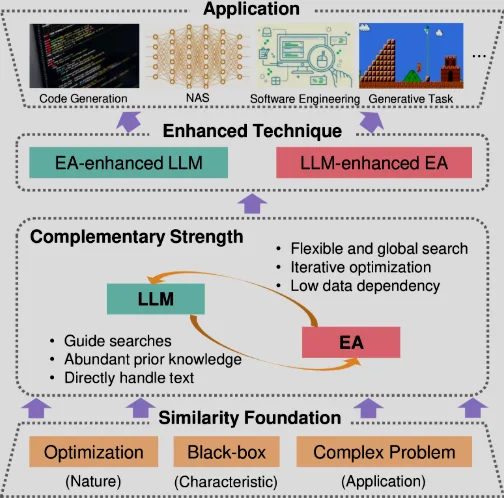
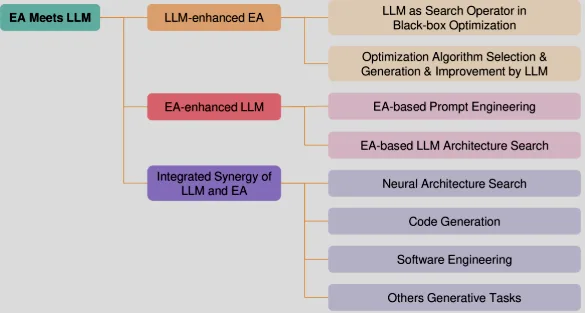
When Large Language Models Meet Evolutionary Algorithms: Potential Enhancements and Challenges
Chao Wang, Jiaxuan Zhao, Licheng Jiao*, Lingling Li, Fang Liu, and Shuyuan Yang School of Artificial Intelligence, Xidian University, Xi’an 710071, Shaanxi, China (https://spj.science.org/doi/10.34133/research.0646) (Wang C, Zhao J, Jiao L, Li L,
Liu F, Yang S. When Large Language Models Meet Evolutionary Algorithms: Potential Enhancements and Challenges. Research 2025;8:Article 0646. https://doi.org/10.34133/research.0646)
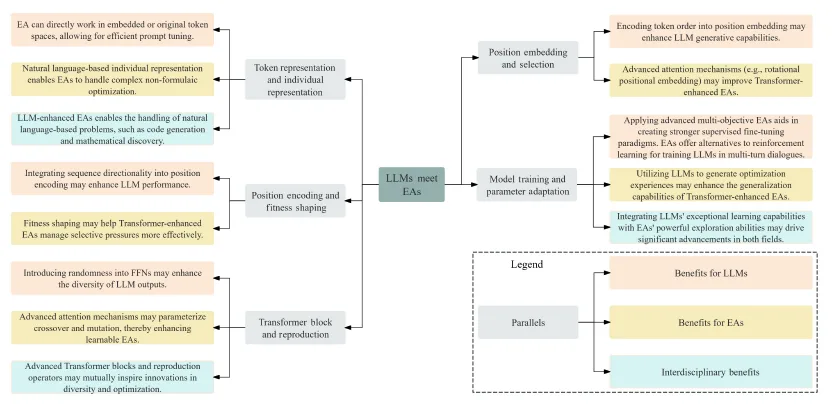
Robert Tjarko Lange, Yingtao Tian, Yujin Tang (2024) Evolution Transformer: In-Context Evolutionary Optimization (https://arxiv.org/abs/2403.02985)
Large Language Models As Evolution Strategies (https://arxiv.org/abs/2402.18381)
Takuya Akiba, Makoto Shing, Yujin Tang, Qi Sun & David Ha (2024) Evolutionary optimization of model merging recipes (www.nature.com/articles/s42256-024-00975-8)