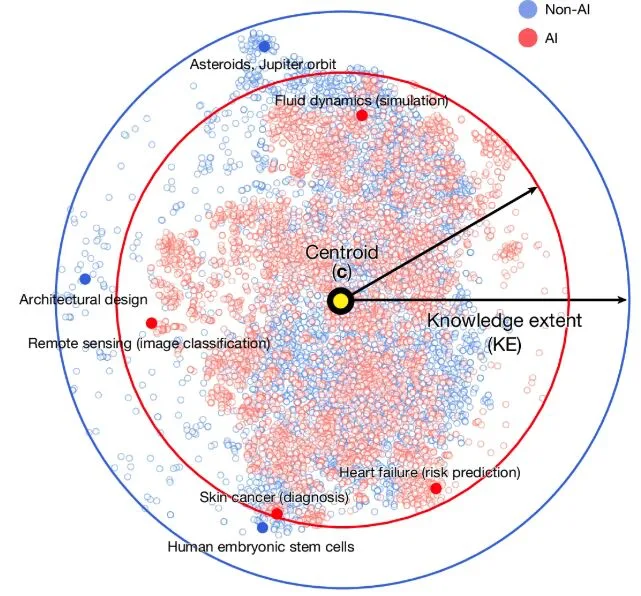
AI-augmented work moves collectively towards areas richest in data
That's an observation from "Artificial intelligence tools expand scientists’ impact but contract science’s focus," an article by 郝千越, Fengli Xu, Yong LI and James Evans that has been circulating as a preprint for some time (lnkd.in/g7i6qjT5) and is now published in Nature Magazine (paywalled at lnkd.in/g9tbCSRa).
The abstract says it concisely: "adoption of AI in science presents what seems to be a paradox: an expansion of individual scientists’ impact but a contraction in collective science’s reach, as AI-augmented work moves collectively towards areas richest in data. With reduced follow-on engagement, AI tools seem to automate established fields rather than explore new ones, highlighting a tension between personal advancement and collective scientific progress".
This can lead to systemic self-reinforcement of certain areas, in a way reminiscent of the drunken person looking for their car keys on a moonless night under the streetlight not because that's where they are likely to be located but because that's where the light is shining. Imagine that during a drunkenness epidemic everyone is looking for their car keys under the same lamppost: a reasonable policy would be to add more lighting to that area. Or consider Wald's bullet holes in the wings of returning planes during WWII. But here scientists (may) have agency: they can and should create AI-ready datasets that touch upon new fields. The problem is one of incentive: if individual researchers can increase their "impact" (here, the "production and visibility of [their] science"), why bother? And dataset creators need to be recognized and rewarded, outstanding scientists such as Fei-Fei Li (ImageNet) and Margaret Oakley Dayhoff (ProteinDB), whose work enabled AI breakthroughs in science.