The cell is not a soup
A recent fantastic Science Magazine article by a group at the Massachusetts Institute of Technology led by Richard Young and Henry Kilgore of the Whitehead Institute and Regina Barzilay of MIT Computer Science and Artificial Intelligence Laboratory (CSAIL) highlights the complexity of the cell.
In "Protein codes promote selective subcellular compartmentalization", the authors take on the fact that the eukaryotic cell, far from being a uniform, well-stirred soup, is highly heterogeneous with many organelles, structures and compartments.
How can cells distribute billions of protein molecules to the appropriate compartments in such a way that proteins involved in shared functions assemble in the same location? By adapting the Evolutionary Scale Model 2, a protein transformer language model, they discovered shared protein codes for collections of proteins that assemble in specific compartments. The adapted ESM 2 combines with a classifier (the entire model being called ProtGPS) to predict with stunning accuracy the probability of a protein being found in each of the 12 condensate compartments. The image below is from the paper, links in the comments.
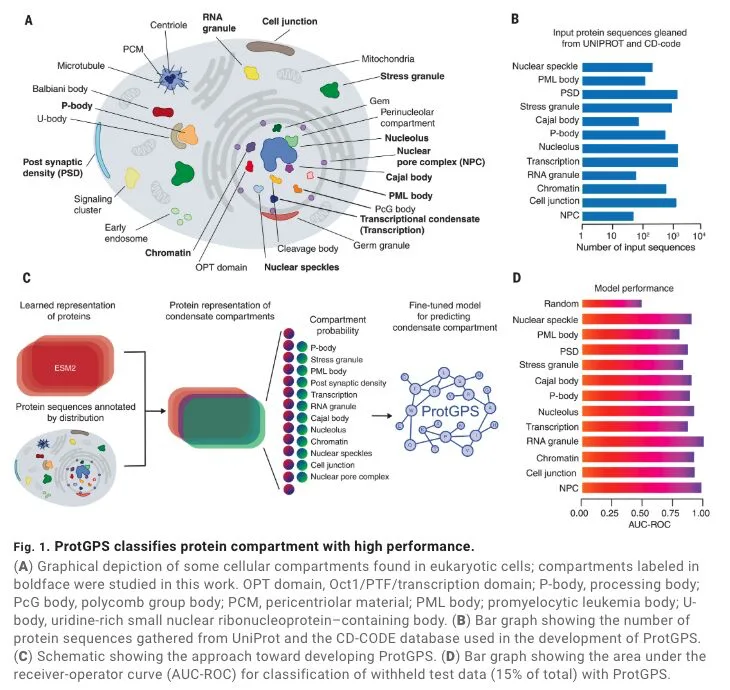
Beyond the computational and scientific tour de force of this study, the predictive model can serve as an input to a spatially extended (virtual) model of the cell, as advocated in the inspiring (and aspirational) December 2024 Cell by Cell Press article "How to build the virtual cell with artificial intelligence: Priorities and opportunities". We are still far from understanding the full complexity of the cell but we are coming to terms with the myth of DNA as code in uniform soup.