A recent blog post by the always insightful Elliot Hershberg caught my
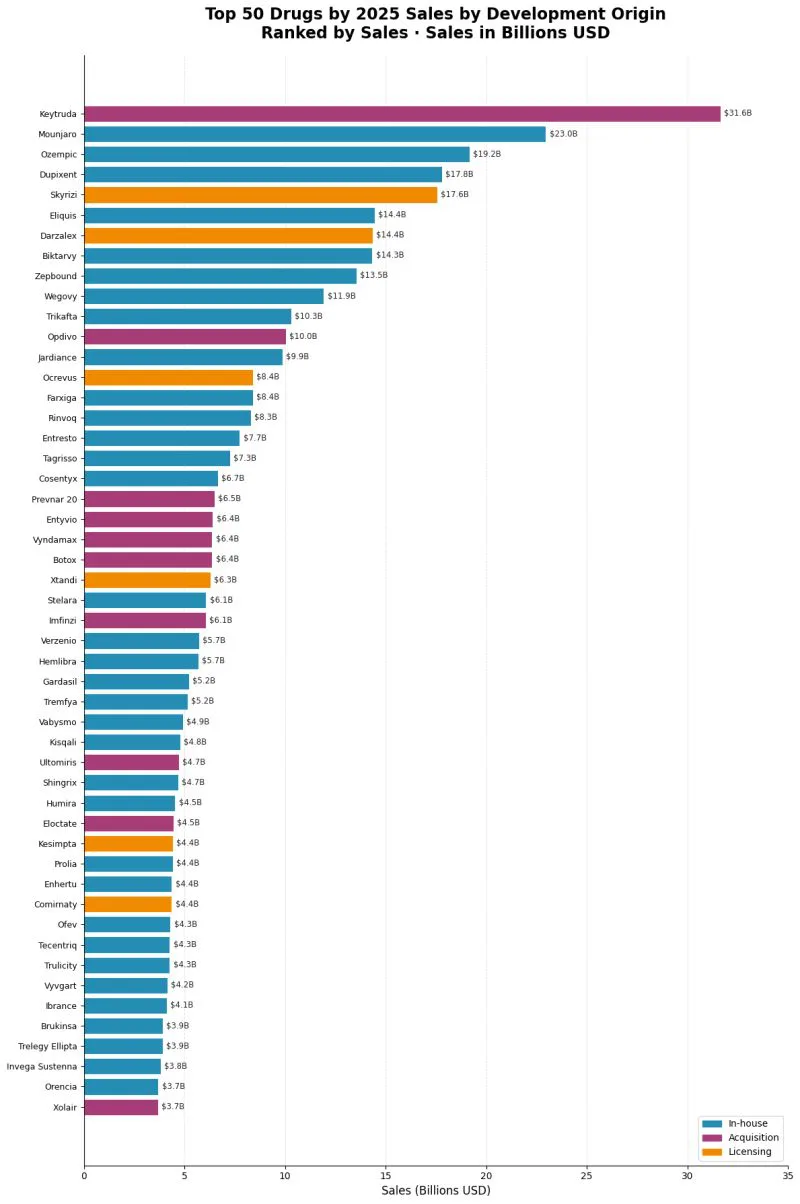
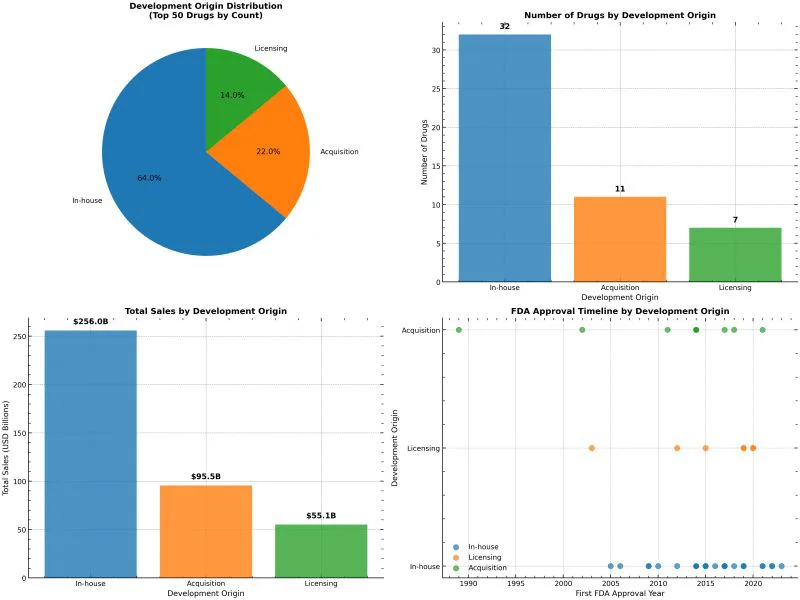
A recent blog post by the always insightful Elliot Hershberg caught my eye: "AI Versus Eroom's Law." I agree with much of his perspective on AI and how it can impact R&D productivity and value, a timely post as Steven Paul, Aaron Schacht and I are putting the finishing touches to a 2026 update to the celebrated 2010 article "How to improve R&D productivity: the pharmaceutical industry's grand challenge" (Steve Paul et., Nature Reviews Drug Discovery volume 9, 203–214). 🫸 But there is one thing that needs clarifying. - Yes, the NUMBER of biotech-pharma licensing deals and acquisitions has grown fast since 2000 - Yes, Big Pharma has relied more and more on external innovation - Yes the proportion of Phase 1 clinical studies run by biotech firms is > 60%. ➡️ But a disproportionate amount of the VALUE generated by Big Pharma comes from in-house programs. And a disproportionate amount of VALUE (in $) comes from Big Pharma sales. Look at the top 50 drugs ranked by 2025 sales below and you will see that even if you removed GLP-1s (Ozempic, Zepbound and Wegovy), sales of drugs developed entirely in-house account for 60% of total sales. With the GLP-1s, it’s 70% and likely to grow as the mega-blockbusters continue to grow. On the external innovation side Keytruda is a big outlier, acquired by Merck via the Organon->Schering-Plough->Merck string of acquisitions; add BMS's nivolumab (Opdivo) from the Medarex acquisition. These two drugs alone generated more than $40bn in 2025 and both face loss of exclusivity in 2028. Merck has been on an aggressive licensing and acquisition spree to prepare for the event, and it is true that biotech licensing and acquisitions by Big Pharma have picked way up in recent months. But it is yet to be seen in “value”, the amount of sales these deals will lead to down the road. I am rooting for the little (biotech) guy here, so I am hoping that the picture changes, where biotech captures a larger amount of financial value. And let’s not forget patient value, which is not measurable in $ only, especially for less prevalent diseases. That is almost by definition the exclusive realm of biotech, as the notion of blockbuster for Big Pharma has moved from $1bn peak sales to $5bn-$10bn. Let’s go!