This is mind-blowing work by Nikolai Slavov, Shira Tsour and team.
This is mind-blowing work by Nikolai Slavov, Shira Tsour and team. And it goes to show how little we still know, and how blind our tools are to what is really going on inside cells. RNA-Seq was supposed to provide a snapshot of the active transcriptome and allow us to determine which genes are turned on or off and how heavily they are expressed... Not so fast! Scientific progress is very much driven by the instruments developed to extend human reach. This promises a new universe of discoveries.
Nikolai SlavovNikolai Slavov • 2ndVerified • 2ndDirector of Parallel Squared Technology Institute & Distinguished Professor at Northeastern UniversityDirector of Parallel Squared Technology Institute & Distinguished Professor at Northeastern University1w • 1 week ago • Visible to anyone on or off LinkedIn
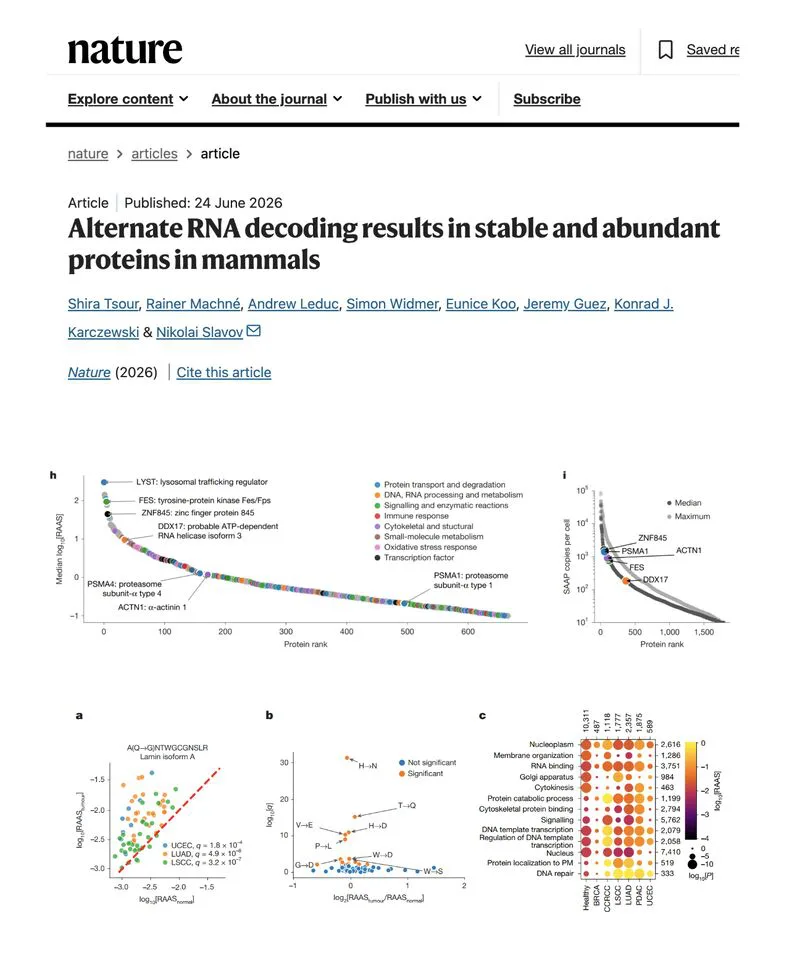
Since the 1960s, the genetic code has been used to predict protein sequences from DNA and mRNA sequences. Our Nature article demonstrates that these predictions miss thousands of protein sequences present in human tissues. Across >1,000 human samples, we identified numerous abundant proteins whose amino acid sequences differ from those predicted by the genetic code. These proteins are not rare translation byproducts. They accumulate to thousands of copies per cell. Some are more abundant than the proteins predicted by the genetic code from the same transcripts. Their abundance reflects a combination of alternate RNA decoding mechanisms — including codon-anticodon mismatches, tRNA abundance, and RNA modifications — and selective stabilization of the resulting proteins. The last factor – protein stability – emerges as a major determinant of protein abundance across proteins, proteoforms and cell types: https://lnkd.in/gHeScBNs Alternate RNA decoding is pervasive across functional groups of proteins, healthy and diseased tissues. It affects proteins playing key roles in neurodegeneration, and some alternately decoded proteins show strong enrichment in tumors compared to their surrounding tissues. The findings reveal a layer of proteome diversity that is largely invisible to DNA and RNA sequences alone. Our knowledge of the proteome remains relatively limited: It is the next big Scientific Frontier https://lnkd.in/eDfJXesp and Parallel Squared Technology Institute is building tools to explore it. This discovery has been a long and exhilarating journey with Shira Tsour and the Slavov Lab team. It started in 2019 and proceeded through many challenges and thrilling highs. A journey that has opened new perspectives that we long to explore! 🔗 Links: Nature Article: https://lnkd.in/gmNBXx-R OA version: https://lnkd.in/eqqJkg84 Science highlight: https://lnkd.in/esKDBq3B