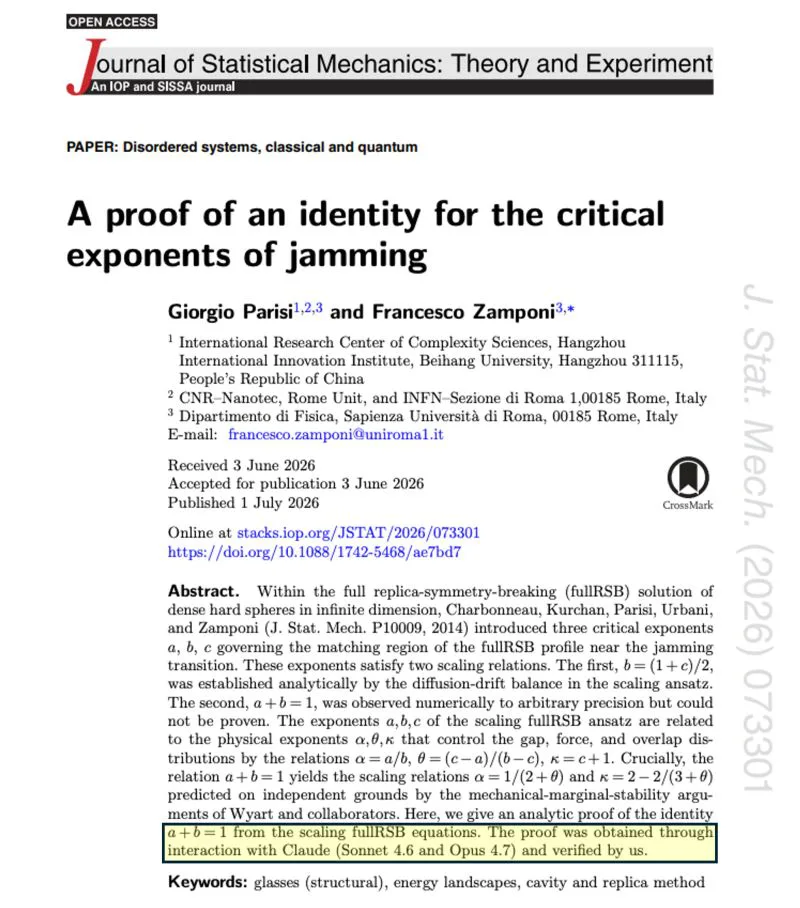
This is an "old" post by John List (4 months in AI
This is an "old" post by John List (4 months in AI time is like 4 years). But it is still worth commenting upon: 1️⃣ First, I agree with the fact that AI is making people with knowledge and critical thinking skills more, rather than less, valuable; List's observations are similar to many experiences I've had this year. 2️⃣ It misses one crucial point, which is quite weird for an educator: how do you grow students into critical thinkers with knowledge if they always bypass the hard stuff to get to the answer? It requires a complete rethink of academia and probably a very chaotic phase until it is figured out. So yes, creating knowledge still matters -meaning, useful, relevant knowledge, not stochastic reformulation of bits and pieces. But the pool of people capable of creating such knowledge may shrink fast and furious. The academic rethink is urgent.
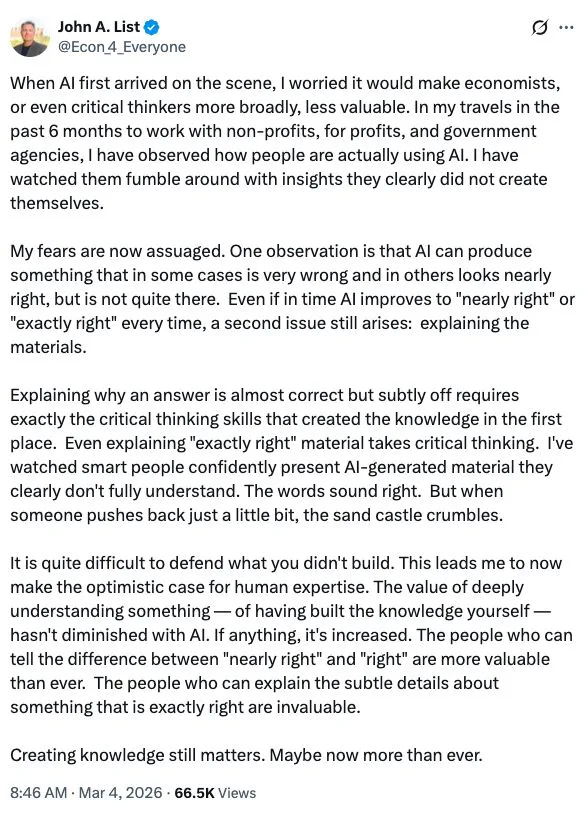
What Terence Tao is to math, Giorgio Parisi is to statistical physics. Let's pay attention. 🤩 Parisi is basically leading by example, and giving us, normal humans who dabble in science, permission to engage transparently with AI in scientific discovery without shame. This is a remarkable paper by Giorgio Parisi and Francesco Zamponi, for a number of reasons. It had been an ArXiv preprint since June 3rd and just got published (received and accepted on the same day, why?) less than one month after it made its appearance. While the result itself is important to statistical physics in that it not only proves an identity but also bridges two very different approaches to the problem (jamming), it is the method employed and who wrote the paper that make this paper extraordinary. Here is why: one of the most brilliant statistical physicists ever (and dare I say, complex systems scientists) and Nobel laureate Giorgio Parisi and his long time collaborator and former PhD student Francesco Zamponi, acknowledge and explain how interacting with Claude put them on the path to a proof that had eluded them for years and a bridge to a different approach (full replica-symmetry-breaking ↔️ mechanical-marginal-stability). They verified the proof. To summarize: 1️⃣ With colleagues, they made seminal contributions to jamming theory beginning in 2014 using the full replica-symmetry-breaking approach. A beautiful result. 2️⃣ A different approach (by a team involving Zamponi) using physical, particle-level analysis, dictates that jammed packings sit precariously at the brink of mechanical instability. Another awesome result. 3️⃣ Both approaches produce different sets of critical exponents for the jamming transition, when the system goes from fluid to rigid. But the empirical observations and the connections between the two approaches could not be proven analytically. 4️⃣ Knowing what problem to work on (they had been working on it for more than 10 years), knowing what questions to ask (how to prove the relationships?) and being able to verify the soundness of the solution, they were able to solve an important problem. Every ingredient is present: the taste of defining an important and relevant problem, the ability to interrogate and interact with an AI in a meaningful way, the transparency of AI support, and the judgment to assess the AI-proposed path to the solution, leading to a double win, a proof and a bridge. José Morán, Jean-Philippe Bouchaud, Charles H. Martin, PhD, Matteo Smerlak, Andrew White, Dario Amodei