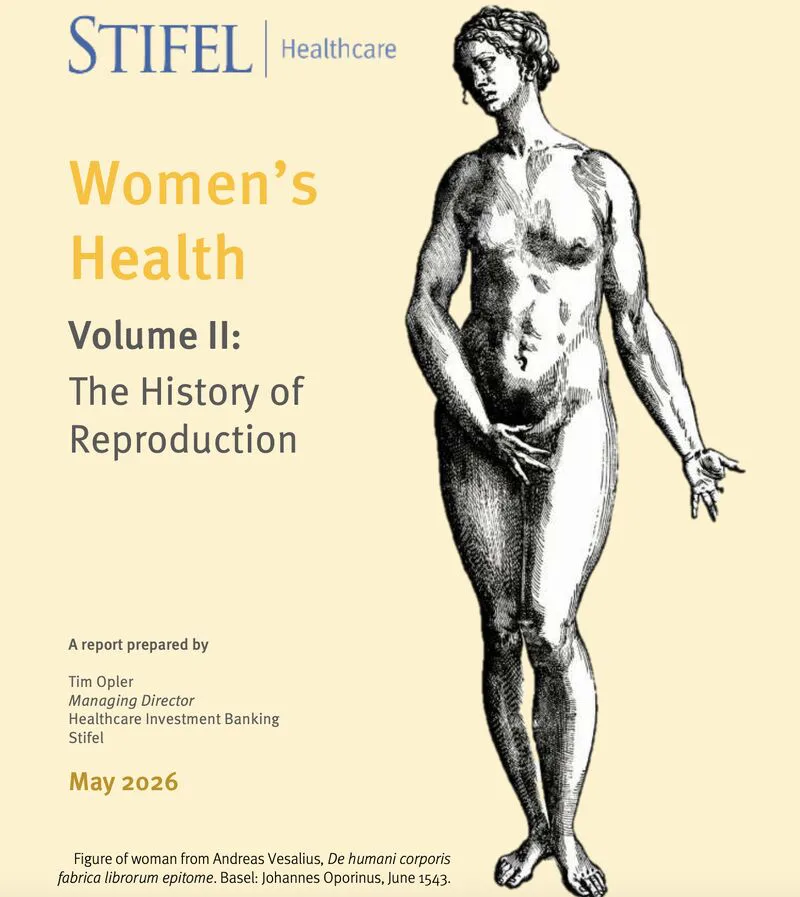
The second volume of Tim Opler's Women's Health history is finally out!
The second volume of Tim Opler's Women's Health history is finally out! It has all the hallmarks of Tim's outstanding reports. To be clear, this is a retrospective volume and as such does not lay out what the future may look like. As usual, I learned a ton. Women's Health Volume II: The History of Reproduction traces human reproduction across five domains: sexuality, embryology, IVF, obstetrics, and contraception. It documents the dramatic decline in UK maternal mortality from 1.7% per birth in 1650 to near-negligible today, driven first by midwifery training and forceps, then in the 1930s–40s by sulfa drugs, transfusion, and Caesarian section. It charts how views of sexuality shifted from Greek humoral cosmology to Christian moralism to Victorian pathologization to modern sexology, and how embryology evolved from Aristotelian epigenesis to von Baer's mammalian ovum and Morgan's genetics. It highlights IVF's redefinition of reproduction, culminating in Louise Brown's 1978 birth. It closes on contraception and argues this innovation has now "defused the population bomb" so thoroughly that fertility collapse is the new concern. While we eagerly await the next volume for a more forward-looking perspective, I singled out 3 themes that dominate the present, and some issues with the report itself: 1️⃣ Humanity has gone from fearing planetary overpopulation to a world where two-thirds of the population lives in below-replacement countries (Japan 1.25, South Korea and Taiwan below 1.0). 2️⃣ Assisted reproduction is a "modular" field that is still expanding. He notes that ICSI, preimplantation genetic testing, egg freezing, and gestational surrogacy have turned reproduction into a modular process separable into genetic, gestational, and social components. We might expect further modularization (and the ethical/commercial questions around it) as the live frontier. 3️⃣ Maternal mortality in the developing world is a big unfinished business. The report flags that the major remaining burden of maternal mortality is in Sub-Saharan Africa, suggesting that's where obstetric progress still has meaningful room to run. My issues, which shouldn't detract from the overall quality: 1️⃣ Marion Sims, the "father of American gynecology", developed the vesico-vaginal fistula repair by operating on enslaved Black women (Anarcha, Lucy, Betsey) without anesthesia and appears only once as a "complex character." 2️⃣ Race is essentially absent. No Henrietta Lacks, no engagement with race in reproductive medicine (but for the Puerto Rico mention). "Women" in the report is largely an undifferentiated category. The lens is on Western European and American women. 3️⃣ The hero structure remains male. Despite the female figures included, the turning points are still narrated through male scientists. Women appear, but they appear within a great-men-and-great-books framework, not as the structural center.