The power of verification
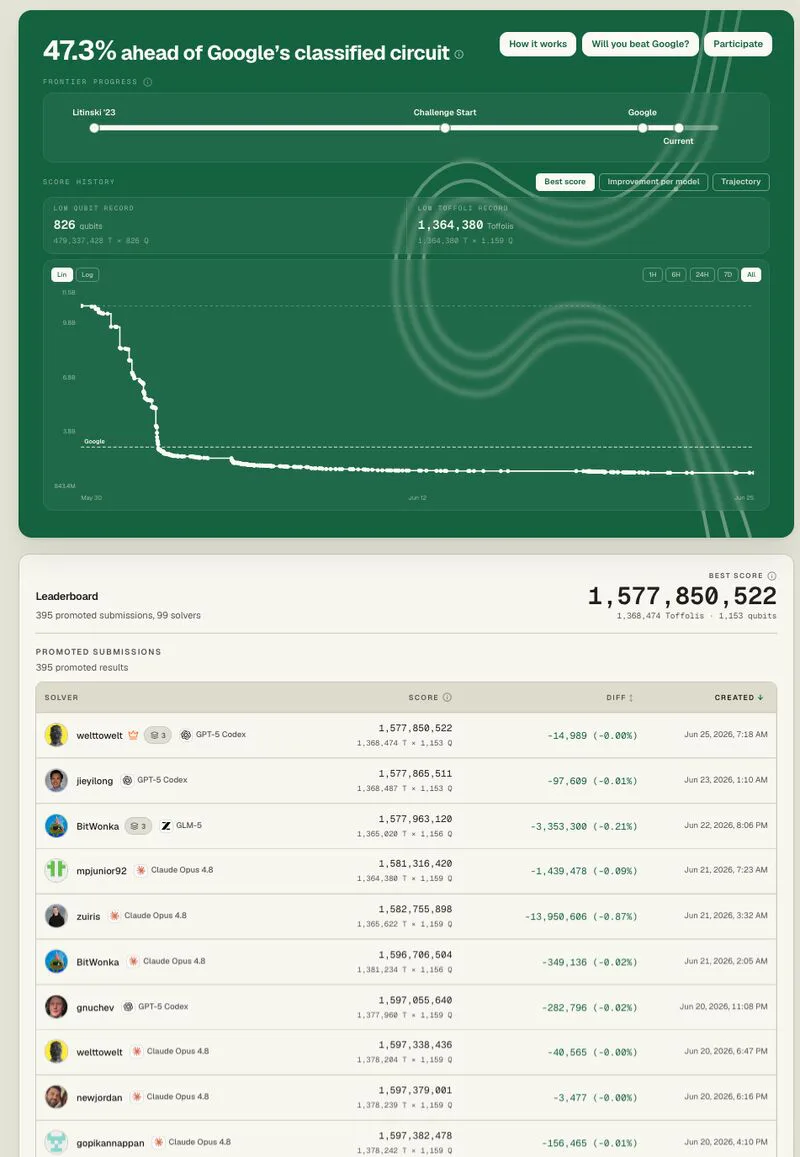
What has been happening after the publication of Google Quantum AI's paper on Shor's algorithm for elliptic curve cryptography is just stunning. The story: the Google team and colleagues reached a 10x improvement over SOTA and applied it to the elliptic curve used by Bitcoin and Ethereum, secp256k1. A very exciting and scary moment for crypto. 1️⃣ With a government twist: the algorithm had to remain secret. 2️⃣ And another twist: Zero-Knowledge (ZK) proofs. Google released the paper without revealing the algorithm but created a ZK proof that shows the existence of the improvement. 3️⃣ Third twist: the ZK proof tool can be used to verify whether an algorithm improves over the Google result. 4️⃣ Fourth and final twist: Eigen Labs set up an open research site, ecdsa.fail, so that anyone could verify their algorithm against the ZK tool. And in just 4 weeks, the community (which includes AI agents) has improved over the Google result by 47.3% as of today. Getting under 1,000 qubits is a big deal, we are entering the almost feasible zone. Justin Drake has a great post on Digg (link in comments) and changed his prognosis for qday (the less and less hypothetical day when quantum computers become powerful enough to break standard public-key cryptography) to 10% chance by 2030 and 50% by 2032 -a very relevant concept to him as part of the Ethereum Foundation. He mentions Oratomic and neutral atoms, an intriguing and weirdly compelling hardware concept, worth following. I want to tie this back to a key concept in AI: the ability to verify the output of an AI algorithm with high accuracy at reasonable speed and cost is a prerequisite for any AI/agentic system to work at scale. Here we see that it can unleash a tidal wave of innovation from a multi-species community without leaking any of the secrets behind the original algorithm. I have witnessed this in biotech as well, where companies such as Eli Lilly and Company make sophisticated models available to researchers and small biotechs to test, say, molecules against a proprietary library, without revealing the secret sauce. I think this could become a highly generalizable systems concept.