The geometric shapes of life on Earth occupy a tiny fraction of the possible
Really cool research and very cool Science Advances paper (OMG these illustrations!) by Guillaume Dera, Elise Nardin, Laurent Risser, Marius Albino, Quentin Garnier, Marion Kardacz and Lea Monge-Waleryszak, Open Access at lnkd.in/gjUttstt They provide some good arguments as to why life on Earth takes on a relatively small number of shapes: physical, metabolic and developmental constraints drastically restrict the space of the feasible.
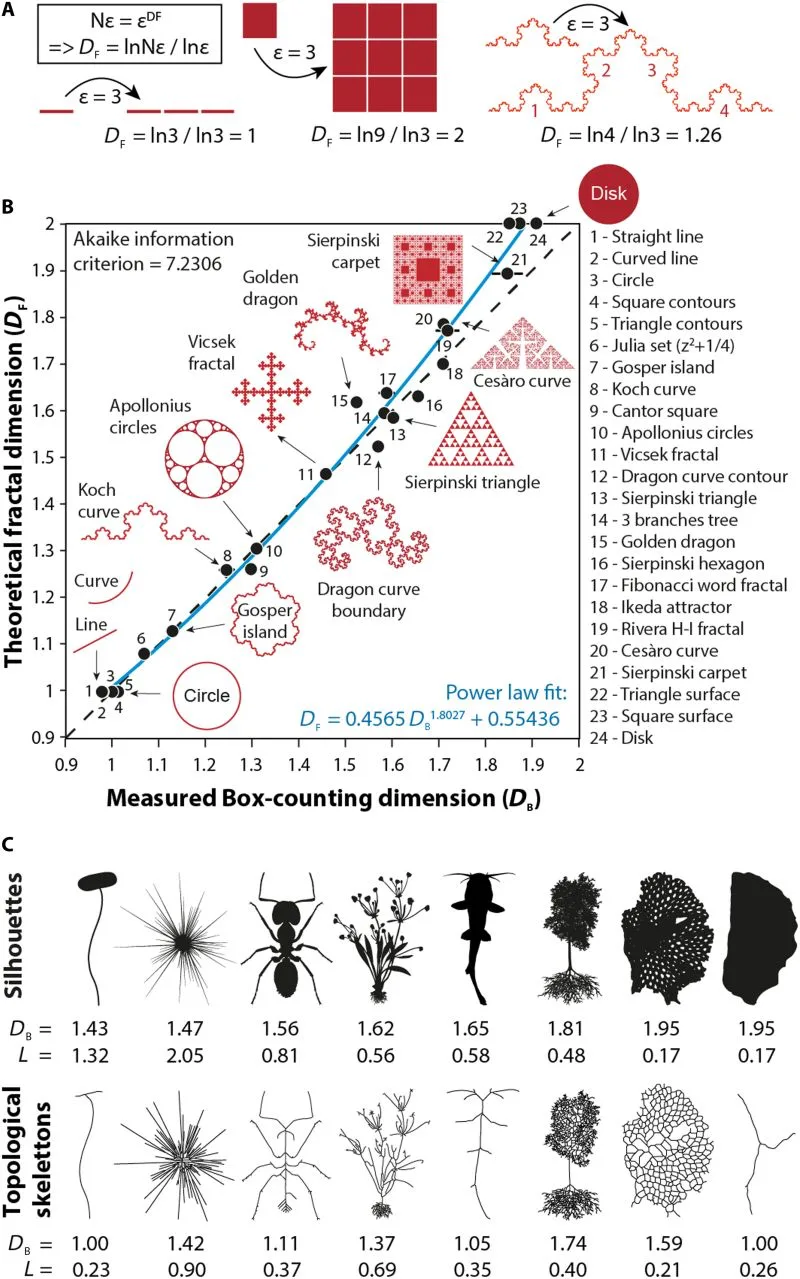
1️⃣ They built a “geometric complexity space” that compares organisms using fractal descriptors of (i) the 2D body-mass silhouette and (ii) its topological skeleton (internal structural backbone), capturing density and heterogeneity without needing homologous landmarks.
2️⃣ How they measured it: For each silhouette + skeleton they computed box-counting fractal dimension (DB) and lacunarity (L), summarized into four parameters DSI/LSI (mass density/heterogeneity) and DSK/LSK (structural density/heterogeneity), with repeated rotations and grid offsets (120 runs per species) to stabilize estimates.
3️⃣ What they compared: Mapped 944 specimens (839 species) spanning unicellular + multicellular phyla, then benchmarked them against ~15k artificial “biomorphs” (superformula + vector-generated shapes) to approximate the “field of possible forms.”
4️⃣ Core finding: Real organisms occupy only ~0.4‰ of the biomorph-defined possibility space, clustering around linear, rounded, and densely structured designs, while largely avoiding highly heteromorphic (chimerical) complex forms.
5️⃣ Body-size pattern: The occupied region shifts strongly with size (e.g., smallest prokaryotes restricted to simple rounded forms; elongation/appendages appear as size increases). The highest disparity and most heteromorphic taxa occur in isotropic aquatic environments around ~10−4 m, near the micro–macro transition in dominant physical forces.
Why the “missing forms”: They argue the empty regions reflect coupled constraints from function (metabolic/exchange needs), fabrication (physics/biomechanics, e.g., ultrathin elongated appendages become stress-limited), and computation (developmental/genetic bias) that make many heteromorphic extremes unlikely or unviable across scales and environments.