Generative exaggeration
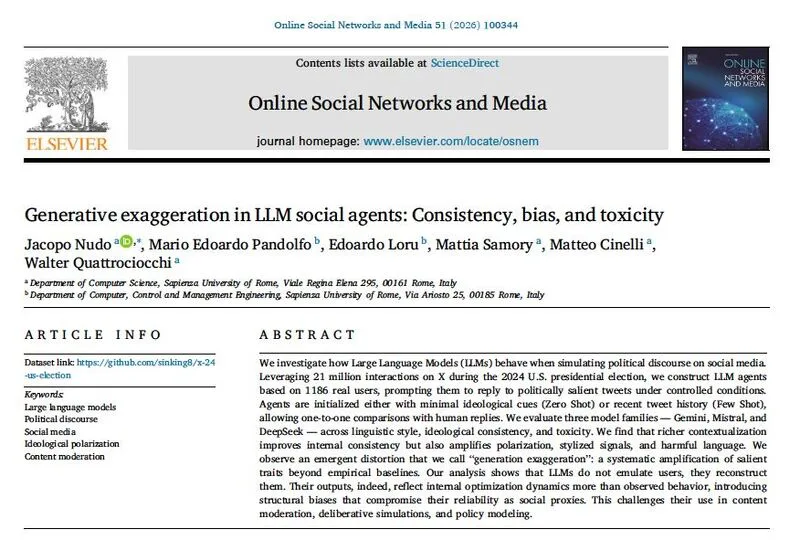
As we're witnessing generative exaggeration in humans on social media discussing LLM social agents (or artificial social crustaceans as David Ha would put it), a timely article by Walter Quattrociocchi and colleagues shows what happens when you use LLMs to simulate political discourse on social media: even though they are supposed to emulate the users whose data they were trained on, they don't; they reconstruct more extreme, exaggerated versions of them, they amplify salient identity traits, reconstructing users with structural distortions.
In other words, these LLM agents do not become subtle when embedded in an agent-based echo chamber. Moltbook anyone? Let's remember that LLM agents are no longer learning, they were pre-trained and fine-tuned; the only thing new is context from other agents, which feeds upon itself toward more extreme traits and polarization.
Open Access! (lnkd.in/g9es6Kx5) "Leveraging 21 million interactions on X during the 2024 U.S. presidential election, we construct LLM agents based on 1186 real users, prompting them to reply to politically salient tweets under controlled conditions. Agents are initialized either with minimal ideological cues (Zero Shot) or recent tweet history (Few Shot), allowing one-to-one comparisons with human replies. [...] richer contextualization improves internal consistency but also amplifies polarization, stylized signals, and harmful language. We observe an emergent distortion that we call “generation exaggeration”: a systematic amplification of salient traits beyond empirical baselines. Our analysis shows that LLMs do not emulate users, they reconstruct them. Their outputs, indeed, reflect internal optimization dynamics more than observed behavior, introducing structural biases that compromise their reliability as social proxies. This challenges their use in content moderation, deliberative simulations, and policy modeling."