The f***g loop has to change
When people talk about “Human-in-the-Loop” (HITL), what they are really talking about is “Human-in-the-Current-Loop”. 👇 I am the human in the current loop when I use Claude Code or Codex and it is a f***g terrible loop: my humanity in the loop has been reduced to my index finger furiously pressing the Enter key or anxiously waiting for the next loop request (it does not help that the intervals between requests are utterly unpredictable and range for 1 s to 10 minutes). The myriad little decisions I need to make are exhausting, so I have outsourced them to my finger: I have basically checked out, as described in The Wharton School's Hamsa Bastani and Gérard Cachon’s preprint “The Human-AI Contract Paradox.” But they approach HITL as "let's change how H behaves", not "maybe there is something wrong with L." 🧠 Draining as they are, these myriad decision requests could be important, or not: they come undifferentiated, so it is impossible to know clearly whether they are important or of no consequence. Pip install pandas? Check. rm -rf *? Check. The only justification for being in this f***g loop is accountability in case anything goes South. A human scapegoat attached to an index finger will then be required. 🤯 That is not sustainable. I know there are band-aid solutions to deal with this particular coding problem, but a real solution demands a complete rethink of the human-AI relationship, not just the interaction, but the whole philosophy and the workflows. Just in the past week, there have multiple articles in medical journals attempting to either justify the “H” in HITL or improve the interaction of the human with AI in the f***g loop. But it is trying to optimize for a system that is deeply flawed: when AI was here and there, adjusting to it was maybe ok, but now that it is pervasive what is left is a kind of fractal gruyere cheese with more randomly distributed holes of all sizes than cheese. People used to think that diagnosis was the clinician’s big cheese, but it turns out that AI is getting much better, which is creating a big hole in the middle. And then there are dozens of other smaller holes, scattered around: some of them may (or may not) be irreducible pockets of human uniqueness, but they are distributed in such a way that just getting to the cheese consumes all the clinician’s time and energy. The old f***g loop no longer makes sense. Time to change the f***g loop (or maybe it doesn't have to be a loop?)
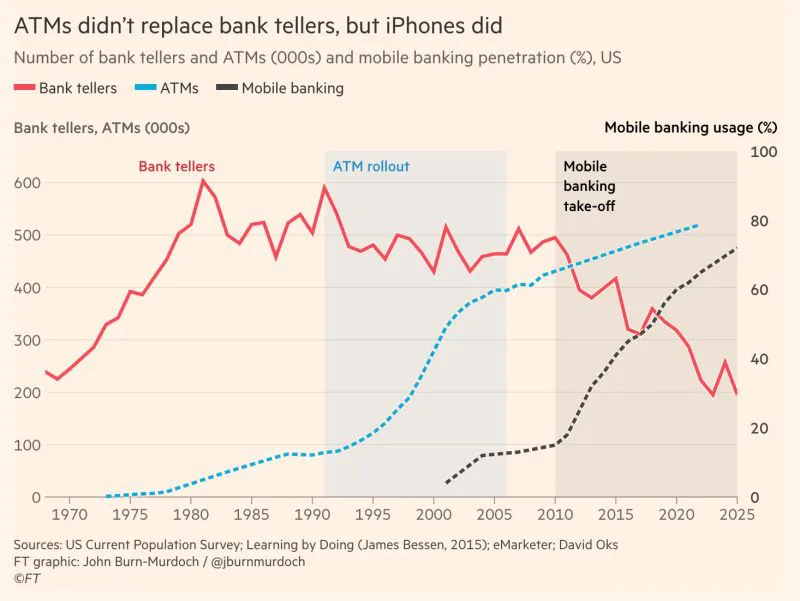
The truncated story of ATMs and bank tellers
As usual, Nicholas Thompson is spreading the good stuff. I think this is a super-important point. The old "ATMs didn't replace bank tellers" story is indeed missing the point: bank tellers were not just cash-giving humans, they fulfilled a lot of other services. When app stores for smartphones emerged, bank apps suddenly made it possible to do things all day long that required being in front of a computer screen until then: it is at that point that interacting with bank tellers became an exception for more and more people. The parallel with AI replacing "tasks" vs AI replacing "jobs" is worth keeping in mind: it starts with limited tasks and at some point a combination of the right UI, UX, workflow re-invention and business model will replace jobs with new workflows that can be implemented entirely by machines. Perhaps new human workflows will emerge as well, but new machine workflows are a 100% certainty and new human jobs to make up for the ones disappearing, well, not as certain.
This graph shows why it’s so hard to predict what a new technology will mean for jobs. It would've been natural to predict the decline of bank teller jobs when ATMs came out—which didn’t happen. It would’ve required a larger leap to do so when Apple released the iPhone—which did. https://lnkd.in/g3Ys7pRM