Of mice and men: "Matthew effect" and lucky breaks
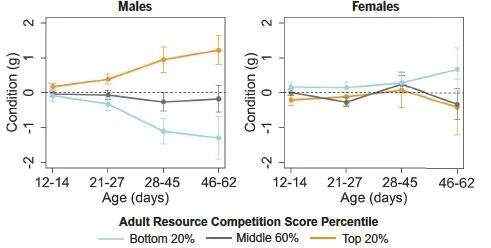
In a clever Science Magazine article "Competitive Social Feedback Amplifies the Role of Early Life Contingency in Male Mice" (paywall but preprint here with a slightly different title: lnkd.in/gCwmQeff), Cornell University's Michael J Sheehan and his colleagues find that small initial differences (for example, small differences in weights) between young, genetically identical mice can be amplified and lead to significant differences among individuals.
⚡ But that phenomenon is observed in male and NOT in female mice. The authors' explanation for this gender difference is that females face less resource competition in the specific setup of the experiment. An excellent overview of this article can be found at lnkd.in/gBhStiJU: "...discovering a shelter early in life might be a small win for a male mouse. When another male mouse finds that shelter, the first mouse already knows the area, making it more likely to win a fight. Winning that interaction matters for the rest of their lives. When two males are competing with each other, the winner of that competitive outcome now has an advantage over the other male [...]. They might have started out approximately the same, but now through some kind of chance-based interaction, one of them is now a winner and one of them is a loser."
The Matthew effect, popularized by Robert K Merton's 1968 Science article "The Matthew Effect in Science: The reward and communication systems of science are considered" (lnkd.in/gzj_VnFc), is based on the the Parable of the Talents in the Gospel of Matthew: "For to every one who has will more be given, and he will have abundance; but from him who has not, even what he has will be taken away." — Matthew 25:29
In other words, those who have will get more and those who don't will lose it. Numerous studies, in humans and animals, have shown that the difference between the haves and the have-nots need not be large: small differences, due to luck or random events, can be amplified and make a large difference later in life. The interesting twist in this article is that it is shown (or least suggested ) to be based on resource competition: in the absence of resource competition, there is no advantage to resource accumulation and small differences remain small, fluctuating around 0.
Back to the Matthew effect in science, the topic of the 1968 paper, access to funding and grants is definitely competitive (lnkd.in/gHXxtzCk). And it also comes with significant gender differences, albeit of a very different nature.