Measurable benefits of treating low-grade inflammation
There is ample evidence that chronic, systemic low-grade inflammation (CLGI) can be a precursor to a number of diseases. Midlife elevations or rising trajectories of hs-CRP/IL-6 predict incident type 2 diabetes, cardiovascular events, late-life brain atrophy and functional limitations.
Inflammaging is the name given to CLGI in the context of aging: it is framed as a pillar of aging that accelerates multiple organ pathologies. Multiple stressors are known to be upstream causes of CLGI, suggesting interventions points. I have my own bias here: gut dysbiosis, also a (relatively new) hallmark of aging.
While working on dysbiosis, leaky gut and other related syndromes that are NOT considered diseases, I have become interested in the big issue of how to show significant health outcomes and economic benefits from addressing CLGI (which is also not a disease). We have two major problems when trying to make a case:
1️⃣ Repeated, modest immune activation across decades, captured by multi-system “allostatic load” indices, predicts later mortality, cognitive and physical decline, consistent with cumulative damage biology: it is the compounding effects of CLGI that lead to diseases. You may have CLGI for 20 years before any clinical event caused (partly of fully) by CLGI. Significant effect sizes of interventions can only be observed after a long time.
2️⃣ Different individuals are likely to experience different paths to disease and to exhibit different diseases. For example, a CLGI-lowering intervention might reduce the risk of diabetes in one person, the risk of atherosclerosis in another and the risk of liver disease in another.
💡 The first problem can be addressed by taking a “long view” and positioning such an intervention as preventing diseases of aging. A number of animal models suggest that lowering CLGI improves healthspan significantly.
💡 The second problem can be addressed in one of two ways (or both): (1) precision medicine, identifying individuals at risk for cardiovascular disease (for example, high Lp(a)); (2) taking a population health or health insurance approach whereby a CLGI-lowering treatment is given as a prophylactic to every member of the population and is likely to have a range of positive effects across a spectrum of diseases.
Regardless of the upstream target (periodontal inflammation, adiposity, gut dysbiosis) and approach (drug, lifestyle), earlier is better but benefits still accrue late.
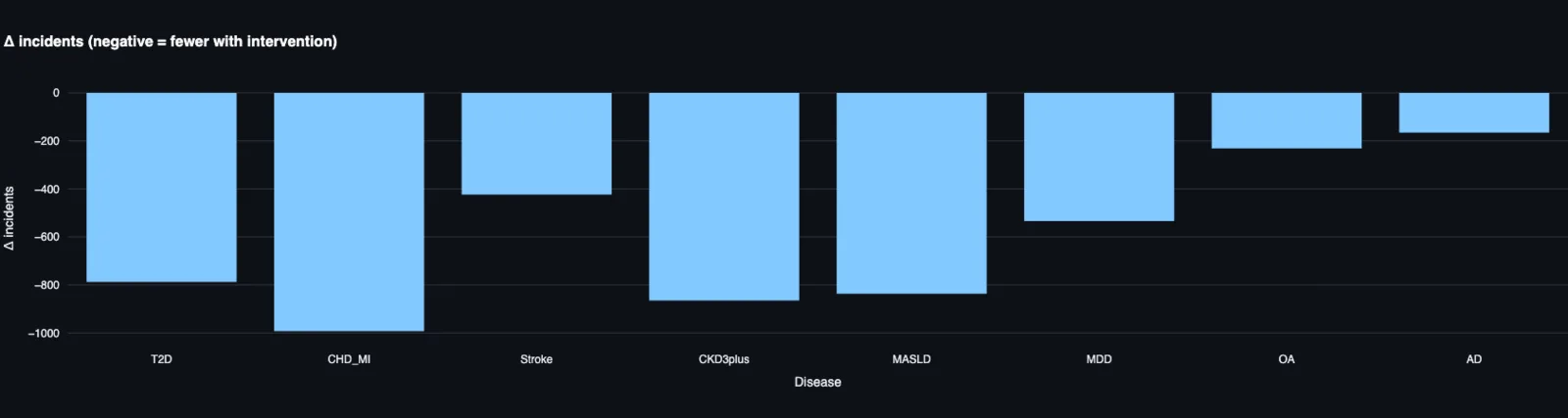
I have built a population model that I will share soon (e.g., below shows incidence reduction in a population of 50,000 over 20 years). It shows that under reasonable assumptions it is economically viable just from a healthcare cost perspective, not to mention regained function and productivity.