Inflammatory lack of pleasure ...
... in depressed patients. A small study (ClinicalTrials.gov identifier: NCT03142919) published this month suggests that patients with depression and a higher level of systemic inflammation are more sensitive to additional pro-inflammatory stimuli when it comes to experiencing pleasure or enjoyment: “Systemic Inflammation and Anhedonic Responses to an Inflammatory Challenge in Adults With Major Depressive Disorder: A Randomized Controlled Trial”, by a team led by @Jonathan Savitz at the Laureate Institute for Brain Research, Tulsa. Am J Psychiatry 182:6, June 2025 (unfortunately paywalled but an insightful open access commentary is available: Anhedonia and Inflammation: Hiding in Plain Sight, by @emory university’s @michael treadway).
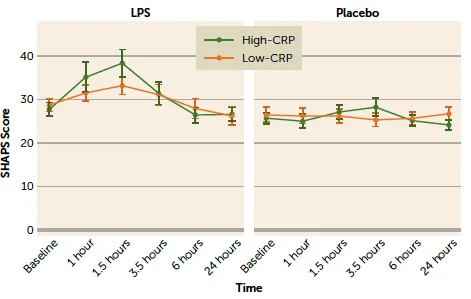
The study stratified the patient population according to their serum baseline levels of c-reactive protein (CRP). From Treadway’s commentary: “All patients were then randomly assigned to receive a single dose of lipopolysaccharide (LPS) (N=32) or placebo (N=32), with measures of anhedonia, depressive symptoms, and plasma cytokines recorded before and after injection. ..all patients who received LPS showed a worsening of anhedonia and (to a lesser extent) fatigue compared with those who received placebo. What was striking, however, is that patients with CRP levels >3 mg/L (high-CRP) showed a significantly larger response to LPS in terms of worsening anhedonia relative to patients with CRP <1.5 mg/L (low-CRP). A similar pattern was observed for plasma levels of interleukin-6 (IL-6), a stress-sensitive cytokine and myokine frequently observed to be elevated in a subset of patients with major depression. While LPS relative to placebo led to significant elevations in IL-6 and other cytokines, high-CRP patients receiving LPS showed evidence of a clear sensitization of IL-6 response relative to low-CRP patients. Finally, when assessing overall depressive severity [...] the high-CRP and low-CRP groups did not differ with respect to other depressive symptoms following administration of LPS.”
In other words, pleasure-seeking was affected and Treadway suggests that lack of motivation due to dopamine suppression might be the reason.
Just one little side question: I know that there are CDC guidelines for CRP levels, but why not stratify the patient population according to LPS levels...? Or at least report on baseline LPS levels?
In any case, a valuable study showing that inflammation aggravates anhedonia and fatigue, the more initially “inflamed” the stronger the effect.
One thing that I will come back to often is the role of LPS: it is an upstream causal trigger of inflammatory cascades and is often used in animal (and sometimes human) studies to model inflammation. I consider LPS a worthy and overlooked intervention target (well, attempts to neutralize it in the context of sepsis have mostly not been uplifting).
https://psychiatryonline.org/doi/10.1176/appi.ajp.20250261
The SHAPS is a 14-item scale that measures anhedonia, the inability to experience pleasure. The items cover the domains of: social interaction, food and drink, sensory experience, and interest/pastimes. A score of 2 or less constitutes a “normal” score, while an “abnormal” score is defined as 3 or more.
www.sciencedirect.com/science/article/pii/S088… Inflammation and metabolic dysfunction underly anhedonia-like behavior in antidepressant resistant male rats