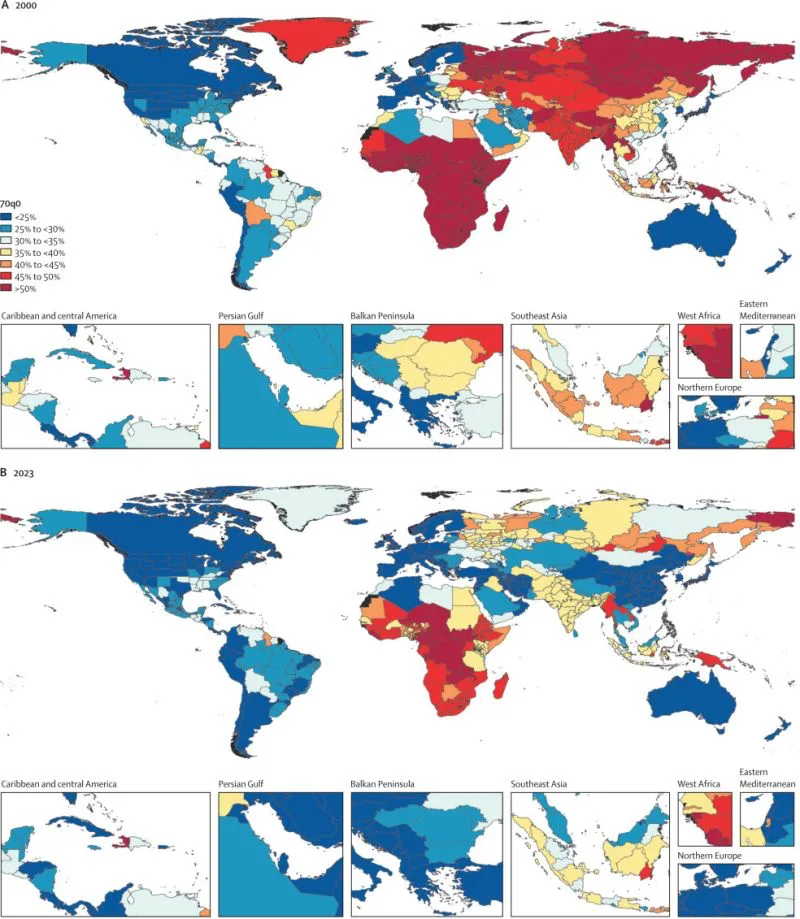
Global Burden of Disease (2)
💡 Another insightful visual from the Global Burden of Disease reports (this one from lnkd.in/gNWuR4Fv). This shows 70q0 in 1990 and 2023. 70q0 is the probability of death between the ages of 0 and 70 years, i.e., the likelihood that an individual born today will die from a specific cause before reaching 70 years of age, assuming that current age-specific mortality rates remain unchanged.
From the article, a gender-specific set of leading causes of death:
1️⃣ "Among the top 50 global causes of death for females, the 15 causes with the largest amount of increase in 70q0 between 2000 and 2023 were interstitial lung disease and pulmonary sarcoidosis (+74·8% change; 70q0 in 2023 0·1%); drug use disorders (+68·0%; 0·1%); lip and oral cavity cancer (+54·7%; 0·1%); atrial fibrillation and flutter (+52·2%; <0·1%); Alzheimer's disease and other dementias (+46·2%; 0·2%); diabetes (+42·7%; 0·8%); hypertensive heart disease (+40·9%; 0·4%); pancreatic cancer (+37·7%; 0·2%); Parkinson's disease (+36·7%; <0·1%); ovarian cancer (+36·5%; 0·3%); other cardiovascular and circulatory diseases (+35·9%; 0·1%); breast cancer (+33·6%; 1·0%); endocrine, metabolic, blood, and immune disorders (+29·9%; 0·1%); chronic kidney disease (+27·7%; 0·6%); and non-rheumatic valvular heart disease (+26·2%; <0·1%).
2️⃣ Among the top 50 global causes for males, the 15 causes with the largest amount of increase in 70q0 between 2000 and 2023 were diabetes (+75·6% change; 70q0 in 2023 1·0%); drug use disorders (+56·8%; 0·2%); atrial fibrillation and flutter (+51·1%; <0·1%); interstitial lung disease and pulmonary sarcoidosis (+48·2%; 0·1%); Alzheimer's disease and other dementias (+45·9%; 0·1%); Parkinson's disease (+44·4%; 0·1%); endocrine, metabolic, blood, and immune disorders (+41·3%; 0·1%); pancreatic cancer (+34·9%; 0·3%); lip and oral cavity cancer (+29·2%; 0·2%); prostate cancer (+24·7%; 0·2%); non-rheumatic valvular heart disease (+23·9%; <0·1%); chronic kidney disease (+18·6%; 0·7%); colon and rectum cancer (+18·0%; 0·6%); urinary diseases and male infertility (+18·0%; 0·1%); and other cardiovascular and circulatory diseases (+15·1%; 0·1%)."