Eukaryotic phase transition?
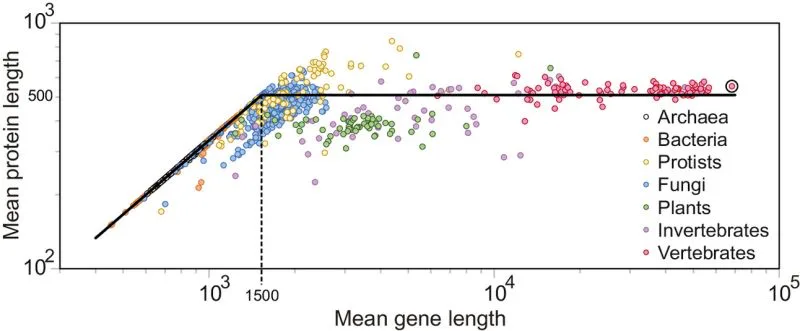
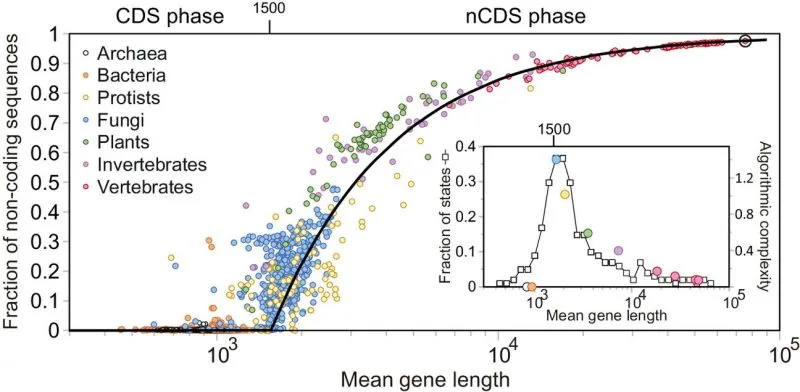
I just came across this fascinating PNAS article by Enrique Muro, Fernando Ballesteros, Bartolo Luque Serrano and Jordi Bascompte, "The emergence of eukaryotes as an evolutionary algorithmic phase transition" (lnkd.in/gAFftXeB). It is a few months old but it tells a super interesting story. The relationship between mean gene and mean protein lengths (for a given organism) is stunning: up to about 1,500 base pairs, mean protein length increase linearly with gene length; beyond that threshold, mean protein length fluctuates around 500 amino acids. This seems to correspond to an increase in the fraction of non-coding genes when mean gene length exceeds 1,500. For any physicist looking at the fraction of non-coding genes, it looks like an order parameter with a (critical) phase transition at a critical value of mean gene length. And prokaryotes are primarily in the "disordered" phase (below 1,500 mean gene length) while eukaryotes are primarily in the ordered phase (above 1,500). The emergence of noncoding sequences in eukaryotes adds a layer of gene activity regulation, introduces new constraints to protein expression and thereby increases the organism's complexity.
The authors argue, with the help of a simple model, that the "shift at the origin of the eukaryotic cell was due to an algorithmic phase transition equivalent to that of certain search algorithms triggered by the constraints in finding increasingly larger proteins". The beauty of the data entitles them to some degree of speculation.