DNA Repair within Reach?
After the discovery that the long-lived, virtually cancer-free naked-mole rat cGAS enzyme, that differs by 4 amino acids from the inflammatory, DNA repair-inhibiting human cGAS, has the opposite, DNA repair-enhancing effect (https://www.science.org/doi/10.1126/science.adp5056) and extends lifespan, here comes a discovery from another long-lived and cancer-free mammal, the bowhead whale (www.nature.com/articles/s41586-025-09694-5).
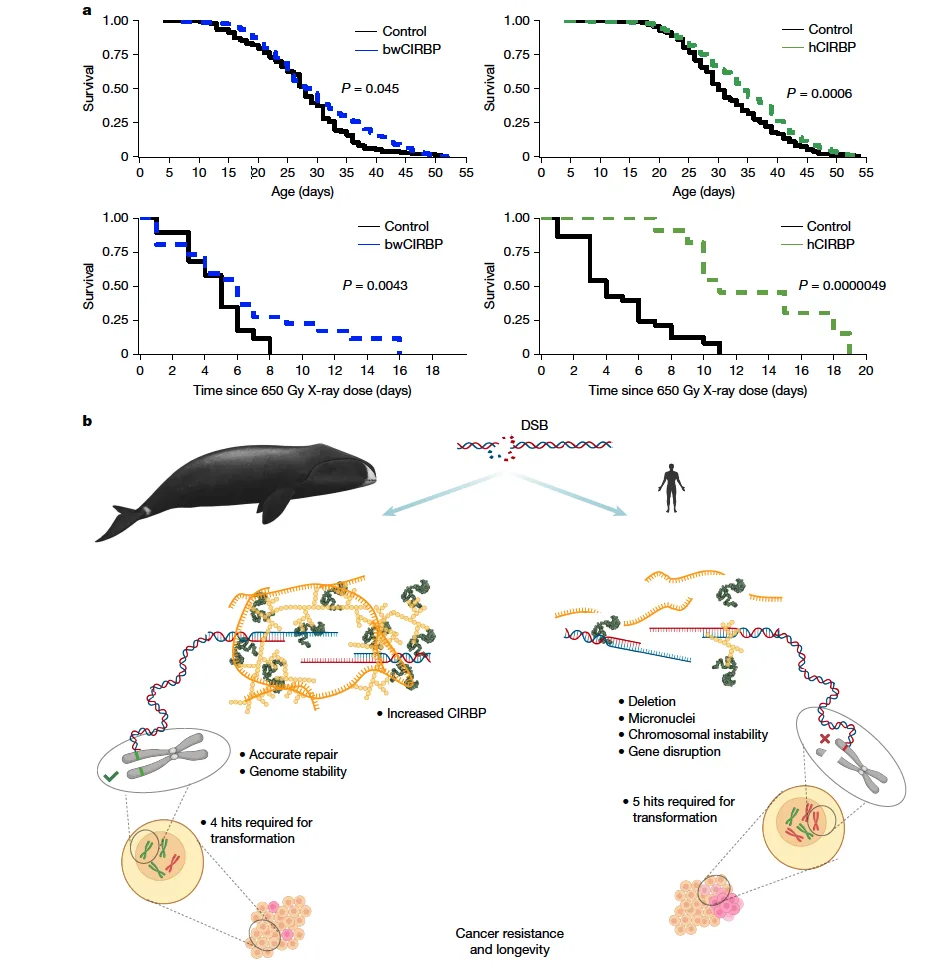
A team lead by @vera Gorbunova, @andrei Seluanov (both @university of Rochester) and @jan vijg (@albert einstein college of medicine) reports that these whales, very large mammals (up to 80 tons) with a maximum lifespan of more than 200 years, has a powerful protective protein that enhances DNA repair. This cold-activated protein called CIRBP (Cold-Inducible RNA Binding Protein) prevents mutations from taking hold and has the same effects in human cells engineered to express it. Fruit flies modified to express this protein were more resistant to mutation-causing radiation.
If confirmed, this finding could apply to humans very rapidly.
First, these two articles together point to DNA damage as a key driver of aging. DNA repair becomes a top objective to address many diseases of aging, including cancer (the accumulation of mutations over time promotes the emergence of malignant cells, making cancer more likely as we age, especially when combined with reduced immune detection and response).
Second, perhaps a more distant possibility for now, the fact that human cells expressing whale CIRBP exhibit improved DNA repair suggests that gene therapy against cell damage could alleviate a number of diseases of aging and dramatically expand healthspan.
Now, things are rarely black or white in biology. Human CIRBP has been shown to have conflicting roles in human cancers, supporting cancer proliferation in some studies and acting as tumor suppressor as others. Hypotheses abound as to how this could be the case, but it is possible that CIRBP reduces the likelihood of cancer but then supports cancer tumors when they emerge.
Or perhaps we just need a cold plunge every morning to activate the enzyme. Did the podcast bros have it right all along?