Distinct neuronal populations in the human brain combine content and context
That is the title of a remarkable study that I didn't see until now (it's like a month old, can you believe??) by a German team, Marcel Bausch, Johannes Niediek, Thomas Reber, Sina M., Prof. Dr. med. Jan P. Boström, Christian Elger & Florian Mormann. It's Open Access (lnkd.in/gy3MznQF)!
At a time when context has become a nexus of AI research (as in "context window"), it turns out that our brains do encode context and that the "coordinated activity of distinct neuronal populations" combine item and context information "to form or retrieve integrated item-in-context memories at the single-neuron level in humans". Or, in the words of a related research briefing (lnkd.in/gJdzK2dy), "brain recordings reveal that two distinct groups of neurons respond to stimuli and contextual information. These groups then cooperate to form flexible memories, rather than individual neurons encoding both signal types."
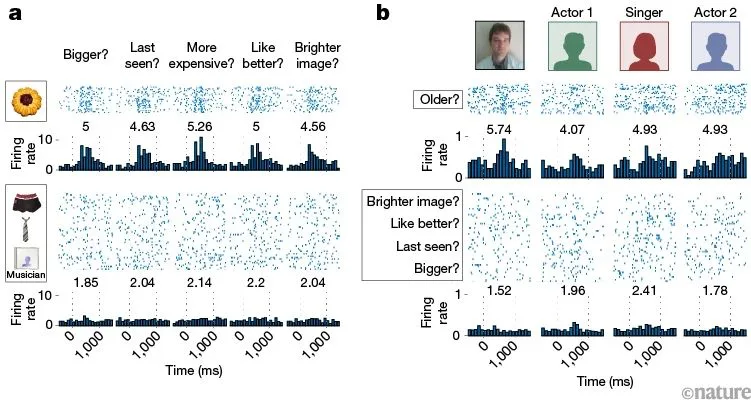
The figure here (from the briefing): Participants compared two sequentially shown pictures (content) on the basis of a previously shown question (context). a, An example of a concept neuron. Raster plots and histograms show neuron firing over time, beginning at picture onset, as a function of the question asked and the picture identity. This neuron responded selectively to the image of a biscuit (top graphs), regardless of the question asked, and did not respond to any other images (bottom graphs). b, An example of a context neuron that fired only when the preceding question was “Older?” (top graphs), as opposed to any other question (bottom graphs), regardless of which picture was shown. Credit: Bausch, M. et al./Nature (CC BY-NC-ND 4.0)