Changing Times Twice a Year Is (Probably) Bad for Your Health
A clever computational model leveraging differential exposures to daylight by US location and the CDC PLACES health data by county was used to determine the possible health outcomes of switching from the current policy (CP) to either daylight savings time (DST) or standard time (SDT). The authors, Lara Weed and Jamie Zeitzer of Stanford University, used a validated circadian model to calculate "yearly circadian shifting time", the cumulative adjustment needed to stay synchronized with the 24-hour day. Correlating this circadian burden to county-level health with a (Gaussian kernel local polynomial) regression model can be used to simulate the effects of changing policies; of course, there is a big assumption here, in addition to all the simplifications/idealizations used: that the correlations have a significant causal component. I personally think this assumption is justified and at least directionally correct. As any sane person would expect, circadian disruption leads to worse health outcomes, which are small at the individual level but significant for public health. Also, these burdens accumulate over time, twice a year.
In simple terms:
1️⃣ They calculated circadian shifting for each county under different time policies
2️⃣ They had CDC health data showing obesity/stroke rates for each county, allowing them to ask, for example, "If a county has 20 hours of circadian shifting, what obesity rate would we expect?"
3️⃣ They used this method to ask: "As circadian shifting increases, how do health outcomes change?"
4️⃣ By comparing shifting under different policies (DST vs SDT), they could estimate how switching policies would affect health
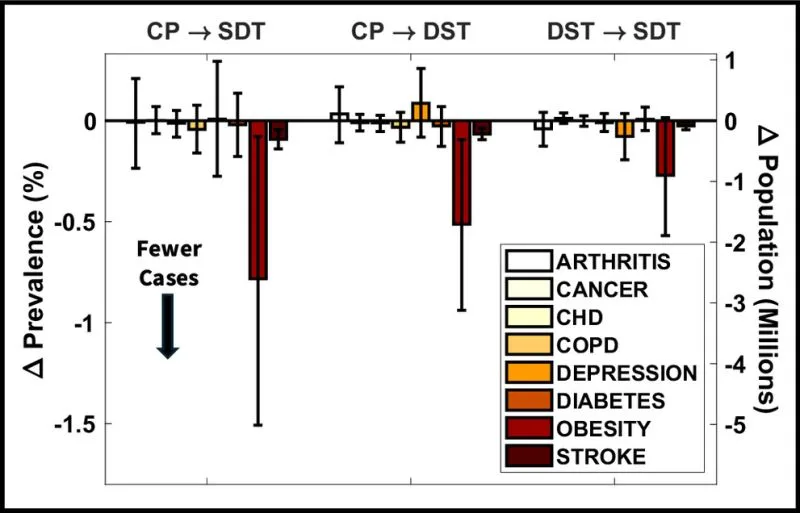
➡️ The result: Counties with more circadian disruption tend to have higher obesity and stroke rates, even after accounting for socioeconomic factors. Permanent Standard Time would reduce obesity prevalence by 0.78% and stroke by 0.09% compared to current policy, with smaller benefits under permanent Daylight Saving Time.
L. Weed, & J.M. Zeitzer, Circadian-informed modeling predicts regional variation in obesity and stroke outcomes under different permanent US time policies, Proc. Natl. Acad. Sci. U.S.A. 122 (38) e2508293122