SleepFM
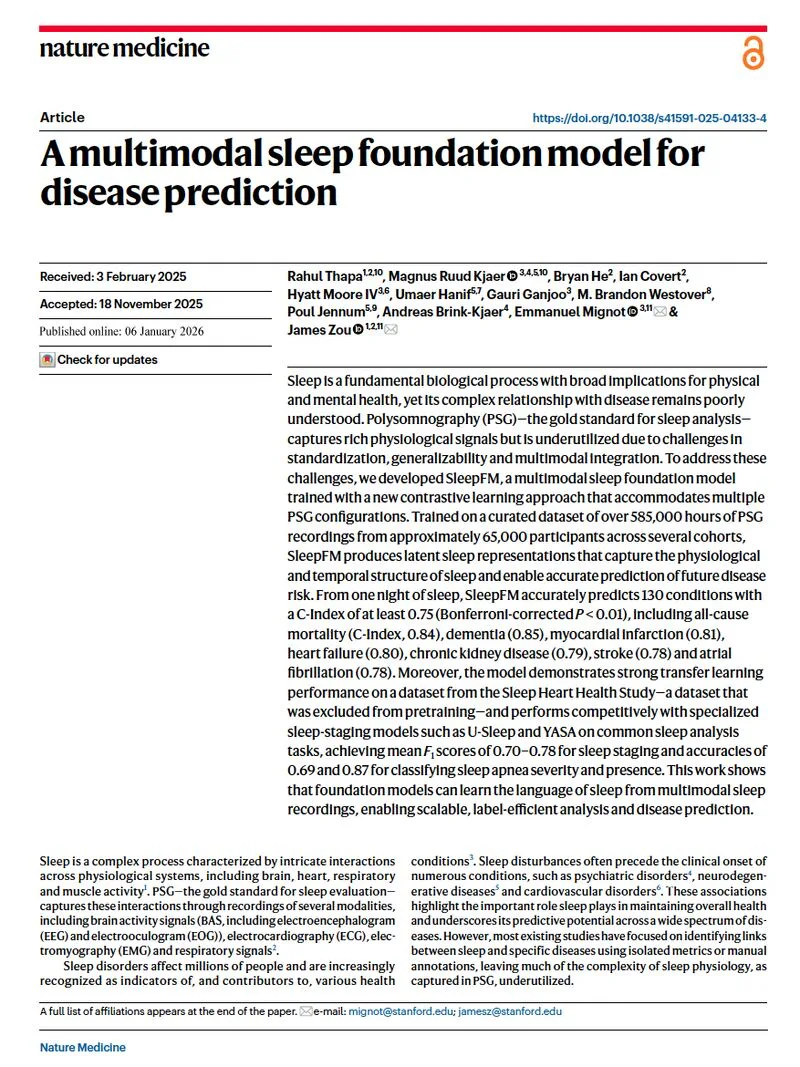
Super-interesting Nature Medicine article (A multimodal sleep foundation model for disease prediction, link in comments) from a team supervised by Emmanuel JM Mignot and James Zou at Stanford University reporting on a new foundation for disease prediction from sleep, SleepFM. While we know that poor sleep is correlated with a range of negative health events, the authors argue that (1) only a small fraction of the data that can be collected around sleep is being utilized and (2) the relationships between sleep data and disease are not well quantified or understood.
To address these issues they used and standardized multimodal (e.g., brainwaves, airflow, leg movements, EKG, blood oxygen) data from multiple large sleep studies and developed a foundation model (a "general" predictive model with good task transfer performance with minimal fine tuning). To measure the performance of the model they used a concordance index (C-index, a generalization of AUROC for survival studies, which looks at whether two individuals experience an event in the order predicted by their respective risk scores) and AUROC for events that occurred between 7 days and 6 years after the measurements. The test data is spectacular: the model predicts 130 conditions with a C-index > 0.75, including all-case mortality and various cardiovascular events.
Let me rephrase because it is worth contemplating: relatively basic data gathered non-invasively during sleep can predict 130 downstream conditions and events. As a foundation model, it also performs well on traditional tasks, such as predicting sleep apnea or sleep staging (i.e., stages of sleep). But what I find mind-blowing is that your sleep data contains "markers" of so many possible adverse health events. The causal relationship might go both ways and/or be mutually reinforcing. But paying attention to, and improving, your sleep is sound advice.
Tony Masri, Jordan Shlain, MD, John Battelle