A More Robust Measure of Gut Imbalance?
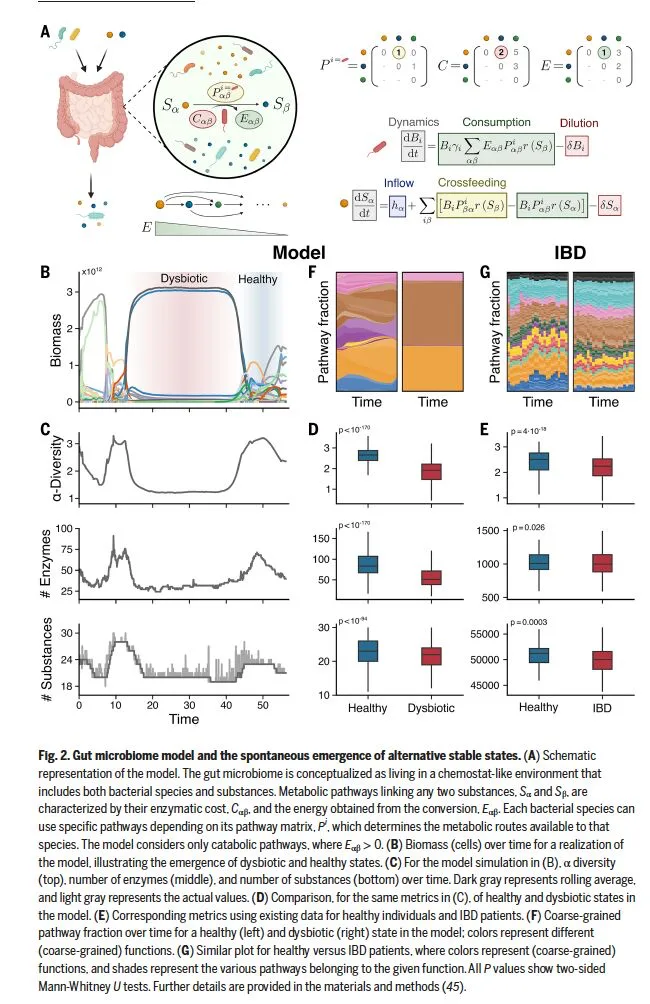
An intriguing article ("Imbalance in gut microbial interactions as a marker of health and disease", Roberto Corral López, Juan Bonachela, Maria Gloria Dominguez Bello, Michael Manhart, Simon Levin, Martin Blaser, MIguel Munoz) came out in Science Magazine last week introducing (yet?) another dysbiosis marker. Commonly used gut “dysbiosis” markers are not consistent across diseases, motivating a search for conserved, mechanistic signatures. The authors build a mechanistic consumer–resource, chemostat-like model that can generate “healthy” and “dysbiotic” states. Microbes differ by which metabolic conversions they can perform and by energy/cost tradeoffs; cross-feeding emerges because metabolic byproducts become resources for others.
In this framework, healthy and dysbiotic states are distinct interaction regimes: they quantify “who helps vs hurts whom” using a net interaction metric ρ, defined as (total cross-feeding − total competition) / (sum of interaction strengths). In the model, “healthy” states show negative ρ (competition-dominated) and “dysbiotic” states positive ρ (cross-feeding-dominated), robust across parameter choices. Dysbiosis tends to be triggered by metabolically compatible consortia that form tight loops/short chains with minimal pathway overlap and can rapidly dominate.
Real interaction networks aren’t directly observed: effective interaction networks are inferred from coabundance data and validated on simulated data. The define ENBI (Ecological Network Balance Index) as the difference between diseased and control ρ. ENBI > 0 means relatively more positive interactions than controls, ENBI < 0 more negative. Across IBD, CDI, IBS, and CRC datasets, ENBI is consistently positive in disease; in CRC it increases with progression.
ENBI appears robust to many technical/biological variations (geography/dietary background, taxonomic profiling pipelines, taxonomic resolution) and is stable across independent healthy cohorts and even a mild dietary intervention, supporting its use as a general dysbiosis indicator.
Clinically, they suggest ENBI could be a noninvasive stool-based monitoring tool, potentially offering early warning and progression tracking (illustrated most clearly with CRC staging data).
I find this very promising, with a many caveats, e.g.:
1️⃣ Marker≠causal connection: targeting a marker may or may not have an effect.
2️⃣ Perhaps the biggest concern I have: inference of interactions from coabundance is assumption-heavy and depends on data quality/quantity, sampling and profiling pipelines.
3️⃣ ENBI is not disease-specific: it does not identify which disease is responsible.
4️⃣ The model ignores a lot of potentially relevant biology.
My hope: longitudinal + perturbation designs (diet, antibiotics, FMT), test whether ENBI changes precede clinical transitions + use multiomics validation