Very exciting paper in Science Magazine this week by a Harvard University
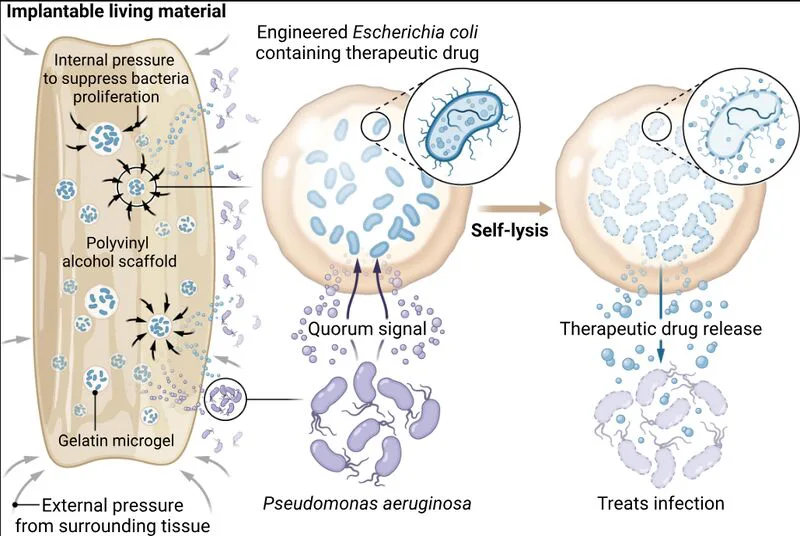
Very exciting paper in Science Magazine this week by a Harvard University and Wyss Institute at Harvard University team led by Dave Mooney: Implantable living materials autonomously deliver therapeutics using contained engineered bacteria. Ok, if it does sound exciting to you, here is why it matters: engineered live biotherapeutics (eLBPs) are living microorganisms (often bacteria or yeasts) genetically modified using synthetic biology to sense, prevent, or treat diseases. They act as localized, in situ drug delivery platforms, traveling directly to target niches (like the gut, skin, or tumor microenvironments) to release therapeutic payloads or neutralize pathogens. In principle they are very promising, yet they have a terrible track record in the clinic for a number of reasons. One of the reasons is that it is very hard to control exactly how much of the eLBP population can do its job properly, how much of it survives or colonizes, whether it can have access to a protected nutrient, and how much of the therapeutic payload it actually secretes under what conditions. The authors designed "a hierarchical scaffold that contains bacteria for up to 6 months by engineering the stiffness and toughness of the material while allowing engineered bacteria to release therapeutic payloads" (from a fantastic Perspective companion piece by Kaige Chen and Quanyin Hu). "This could advance living therapeutics from short-lived proof-of-concept systems to durable, programmable medicines." Figure: Engineered bacteria can sense signals from infections in the surrounding tissue and release therapeutic molecules to treat the site of infection inside a body. Hierarchical biomaterial scaffold consists of bacteria-containing gelatin microgel enclosed in a larger polyvinyl alcohol scaffold. This provides a safe enclosure to suppress bacterial proliferation while withstanding pressure from the surrounding tissue to prevent fracture. The biomaterial scaffold can pass small molecules to and from the surrounding medium for delivering nutrients, biomarkers, and drugs to treat infection for a prolonged period.
A good explainer here: https://phys.org/news/2026-05-implantable-bacteria-safely-major-hurdle.html
Official article: https://www.science.org/doi/10.1126/science.aec2071
Open Access preprint: https://www.biorxiv.org/content/10.1101/2025.10.09.681377v1