Teaching LLMs to reason like Bayesians
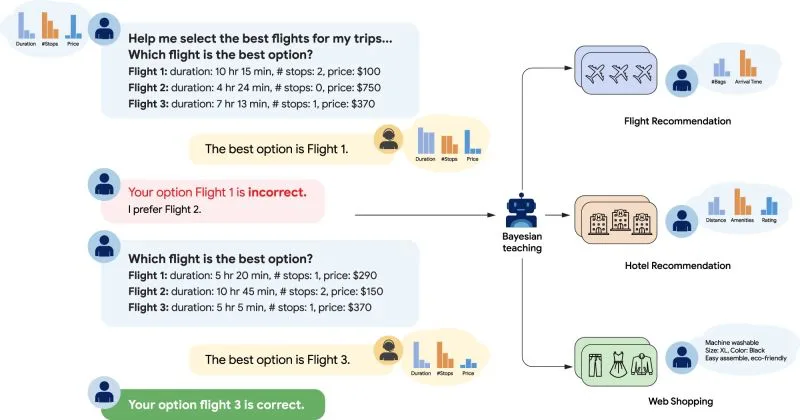
I didn't pay much attention to this article ("Bayesian teaching enables probabilistic reasoning in large language models", Linlu Qiu, Fei Sha, Kelsey Allen, Yoon Kim, Tal Linzen & Sjoerd van Steenkiste, Nat Commun 17, 1238 (2026)) when it came out in January... but I should have. This post's title is borrowed from a Google DeepMind post this week and it conveys the really interesting part better than the article's title. LLMs in general are not "naturally" Bayesian: they don't have ways of updating their "beliefs" or priors based on new information. So the authors found a way to teach LLMs to perform Bayesian updating with supervised fine-tuning. They found that showing the perfect answer each time was not as effective as showing how a Bayesian assistant could improve its responses after early mismatches. The results are actually pretty impressive, doubling accuracy over one or two rounds.
So, very cool work! And it made me think about humans and how we often learn better by witnessing failure-adjustment-failure-adjustment-success than by being exposed to success only. It reminds me of the old adage "Give a man a fish, he'll eat for a day; teach him how to fish, and he'll eat for a lifetime" (apparently from Anne Isabella Thackeray Ritchie's 1885 novel Mrs. Dymond: "If you give a man a fish he is hungry again in an hour. If you teach him to catch a fish you do him a good turn.") Indeed, seeing the perfect output (the fish) does not help him catching more.