Olfaction
👃 I love this introduction to scent design by Taylor Rayne at Asimov Press (Scent, in silico, lnkd.in/gwv7sQ2M) and the role that machine learning and genAI is playing in the field's recent advances: Google DeepMind's Principal Odor Map (lnkd.in/gi_8sP6j), its spinout Osmo's Olfactory Intelligence Platform (lnkd.in/gi74gxS6) and good old Givaudan's Carto, which I assume has evolved since its 2019 launch. Having worked on this issue many moons ago with a form of "active learning" (where a human provides feedback) using interactive evolutionary computing, I appreciate the enormous progress of the last decade, and I thoroughly enjoyed playing with the Principal Odor Map.
One missing piece, and to be fair a very hard nut to crack, is the inverse problem of recording scents. Imagine wanting to recreate the scents of a beautiful morning in Provence or the scents of your youth. While modern olfactory digitization technologies have achieved impressive reliability in targeted, controlled environments (such as food quality control, fragrance development, and certain medical diagnostics), they are not yet fully reliable for digitizing highly complex, real-world olfactory scenes.
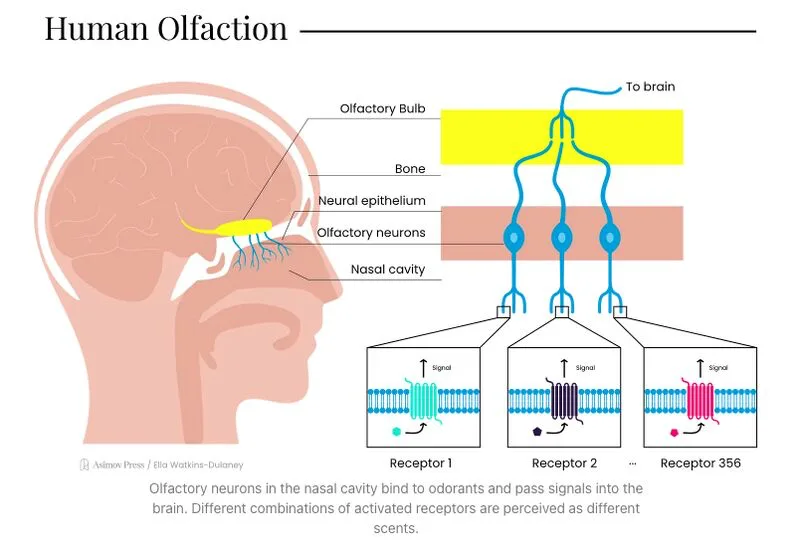
The main challenges include sensor selectivity, environmental interference, calibration drift, and the sheer complexity of natural scent mixtures. Advanced systems using biohybrid sensors and AI offer the best performance to date, but the "digital scent gap"(the inability to capture and reproduce the full richness of natural odors) remains a significant barrier. Separating and identifying VOCs with Gas Chromatography-Mass Spectrometry (GC-MS) is expensive and bulky, e-noses, biohybrid sensors and other approaches have their own limitations. The next frontier is overcoming the challenges of 1️⃣ Sensor Selectivity (difficulty distinguishing similar odorants in mixtures; cross-sensitivity is a major issue), 2️⃣ Calibration & Drift (sensor responses change over time and with environmental conditions, requiring frequent recalibration), 3️⃣ Environmental Interference (humidity, temperature, and background odors can distort readings), 4️⃣ Complexity of Natural Scents (human olfaction uses ~400 receptors; artificial systems cannot yet replicate this combinatorial complexity) and finally the 5️⃣ Digital Scent Gap (current scent libraries and reproduction systems cannot fully capture or synthesize the richness of natural olfactory scenes).