Long term evolution of antibiotic resistance in a bacterial community
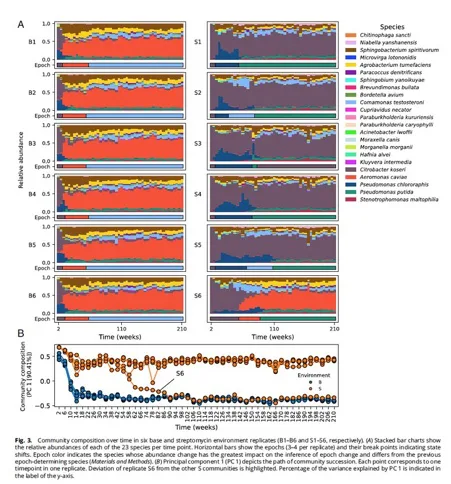
Superb experiment by a team from University of Helsinki, Turku University of Applied Sciences and University of Konstanz published in PNAS: "Evolution induced state shifts in a long-term microbial community experiment" (thx Itzhak Mizrahi for the pointer!). Paywall but preprint available, link in the comments. It's a tour de force: setting up and observing the evolution of a s̶y̶n̶t̶h̶e̶t̶i̶c̶ defined community of 23 bacterial species for 4 years! In his comment, Itzhak focuses, rightly, on the fact that a single mutation in a single species can radically reorganize a community through network feedback. And indeed, it is a stunning extension of Richard Lenski's awesome work on the long term evolution of a single species (E. coli) that I have always held as a pinnacle of experimental evolution. I want to zero in on another aspect of the experiment: the two environments that are compared, one with streptomycin (at a sublethal concentration for some species in the community while sufficiently high to likely select for resistance in many of the community members) and a "control" environment without it. Streptomycin is an aminoglycoside antibiotic still used to treat serious bacterial infections, including tuberculosis (as a second line of treatment, alongside other drugs), plague, and tularemia. Understanding bacterial resistance in a community context is therefore important. The authors show in reproducible & repeatable experiments that "evolution of streptomycin resistance in a previously streptomycin-sensitive species on its own can induce abrupt community state shifts." Experiment S6 in the figure below shows an interesting deviation from the other Streptomycin communities, reverting to a state similar to the control communities after more than a year in the Streptomycin-typical state. What happened is that one species, Aeromonas caviae, acquired resistance, which caused the end state. The authors confirmed by introducing the resistant strain in a stable Streptomycin environment where it led to the same ecosystem-wide state change. Just awe-inspiring work!
Official, paywalled version: https://www.pnas.org/doi/10.1073/pnas.2533269123
https://www.biorxiv.org/content/10.1101/2025.10.10.680894v1