I was wrong (it seems
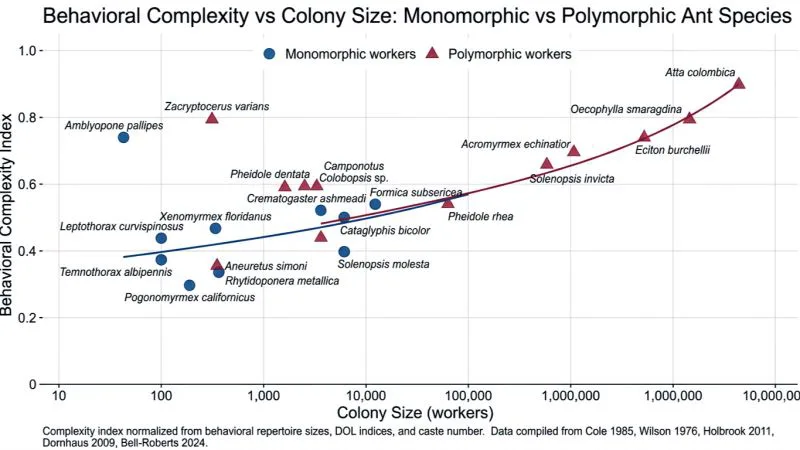
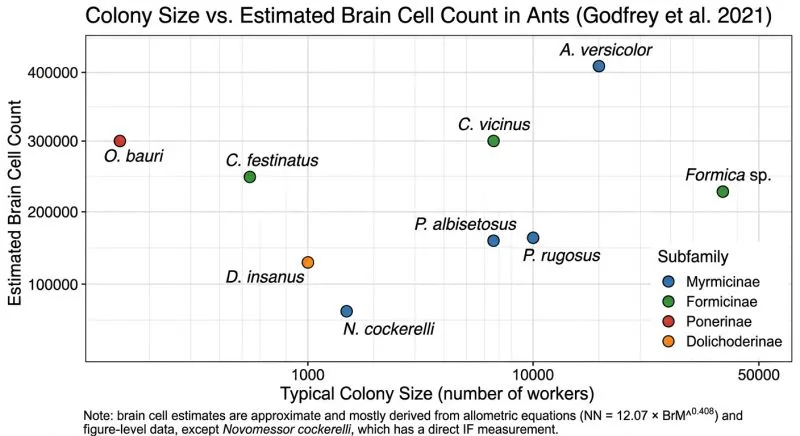
) 🐜 Now for something a bit different for my rabid followers: a long, long time ago, in a galaxy far away, I thought a lot about swarms, real or virtual. And I always had this fantasy of proving that ant colonies are like human organizations: a small startup requires polyvalent workers who can do a bit of everything, while large companies have a lot of specialized workers who focus on only one task. As a result, I had two strong hypotheses, very hard to verify at the time: 1️⃣ Ants in small colonies have a more complex behavioral repertoire. 2️⃣ Ants in small colonies have more neurons 🧠 . With new data and tools, it seems that I was wrong on both counts, although there is not a whole lof data on #2, and the little data we have points to no clear relationship between brain cell counts (not quite neurons but a proxy) and colony size. Re: #1, species with physically different workers (polymorphism) have an unfair advantage as their behavioral repertoire is by definition amplified by physical differences, e.g., large, hard-headed soldiers vs. small nurses. But even within species without polymorphism, the trend is the opposite of my hypothesis, the larger the colony, the more complex the behavioral repertoire. I guess, now revising my initial set of assumptions, that new tasks emerge as a company/colony becomes larger so that the organization needs to fill a wider range of roles. The plots: Colony size estimates (x-axis) reflect typical mature colony sizes from the literature. (1) Behavioral complexity vs colony size across ant species with monomorphic versus polymorphic workers. Monomorphic species cluster at smaller colony sizes, while polymorphic species extend to larger colonies and generally higher complexity. The complexity index was then normalized across all species to a 0–1 scale for cross-comparison. (2) Estimated brain cell count vs colony size for 9 ant species studied in Godfrey et al. 2021. Brain cell values are approximate for most species and are largely inferred from allometric estimates and figure-level interpretation, except Novomessor cockerelli, which has a direct isotropic fractionator measurement.
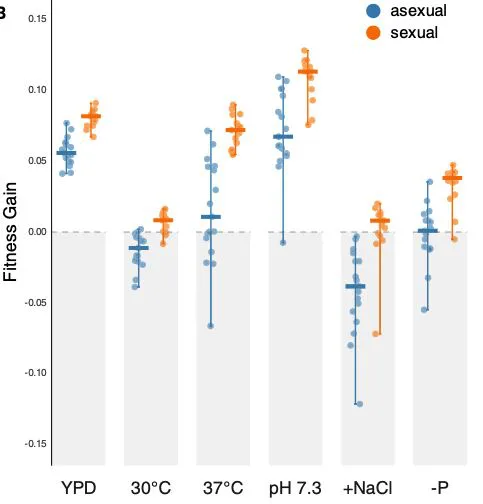
Finally, we know why we have sex Ok, no, not that kind of sex. Sexual reproduction. In a Science Magazine article today, "Sex decreases the pleiotropic costs of local adaptation by purging hitchhiking load", a group of scientists led by Harvard University's Michael Desai examined the maintenance of sex in the yeast Saccharomyces cerevisiae, a species that does not need sex for reproduction. The reason is that "sexual reproduction is a complex and costly undertaking for eukaryotes such as budding yeast, which can also divide asexually". It has been assumed for a long time that the advantage of sex is recombination, which promotes diversity and accelerates adaptation. The novelty here is the changing environment in which the experiments took place. From the Editor's commentary: "The great advantage is that sexual recombination accelerates adaptation and leaves behind deleterious mutations. In an attempt to find out how sex is maintained, [the authors] found that for yeast subjected to a changing growth environment, which is the norm for most organisms, recombination promotes the evolution of generalists. Sexual reproduction is thus maintained in the long term because it reduces the pleiotropic costs of local adaptation and permits the persistence of lineages." What a relief. Article: https://lnkd.in/gnZHmsdf Preprint: https:https://lnkd.in/gTFP4EhQ