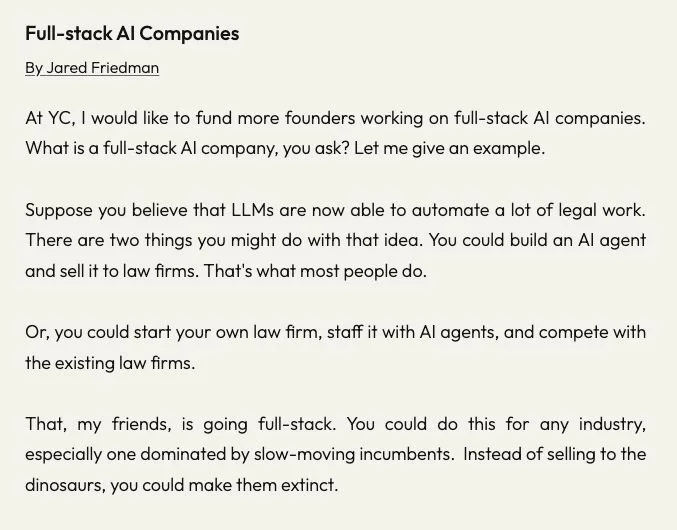
Full-Stack AI companies
I am sure many have seen this Y Combinator's Summer 2025 Request for Startups by Jared Friedman. When I founded Icosystem in 2000, I had this exact concept in mind: if we can do analytics and machine learning so much better than any company in field XYZ, where we accomplish at least 10x reduction in costs and/or cycle time or 10x top line value creation, let's create a "full-stack" company in field XYZ and disrupt the industry. Icosystem was conceived as a venture studio (although the name did not exist at the time) based on an unfair advantage in machine learning and analytics. It wasn't the smashing success I hoped for and that many at the time predicted we would become, and there are lots of reasons for that, some personal, some structural but also, with the benefit of hindsight, timing. Being way early with this kind of thinking can be a recipe for exhaustion, physical, mental and financial.
Here is one example, which I have described before, but it benefits from this new lens: in 2006, having created a powerful machine learning platform for medicinal chemists that leveraged human med chem expertise and combined it with comp chem analytics and evolutionary algorithms, we spun off a company with Eli Lilly, CoalesiX. We had tested the platform with Eli Lilly's comp chem team and their head at the time was so impressed and excited that he joined CoalesiX as chief scientist. With a small series A, CoalesiX developed the software and began its journey in the hellhole of software sales to pharma companies: multi-year sales cycles, high levels of resistance, process changes, zero overlap between users, buyers and decision makers. It also took a different kind of mindset to really harvest the full value of the platform.
After 18 months or so, the path forward was clear: become a drug discovery company, all the way to pre-IND or even clinical POC (I was involved with Eli Lilly and Company's Chorus at the time). Investors laughed at us: you need an asset to develop to get funding. After returning the remaining money to investors, I tried to get this concept funded to no avail, until about 2010. Exhaustion.
It is not until the mid-2010s that companies such as Insilico Medicine emerged and followed a somewhat conceptual trajectory, becoming "full-stack" biotech companies. The difference is that this time investors and pharma companies took the idea seriously: more powerful technology plus a critical mass of companies with great talent penetrated the zeitgeist. Interestingly, Insilico has kept its software business and it generates real revenue. Recent partnerships between big pharma and startups such as Chai Discovery, NOETIK, Boltz and others (I hesitate to call Isomorphic Labs a startup) show how seriously they are taking AI and machine learning.
In 2026, the situation has almost inverted: a lot of AI companies start with a mission to be(come) a full-stack competitor in an entrenched industry. Timing.