Evolution is definitely back, Part II
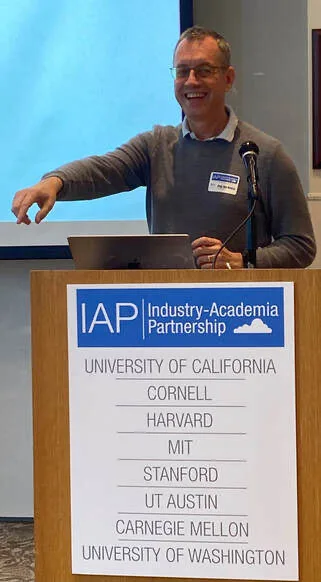
At a recent "Workshop on AI in the Cloud" at UC Berkeley organized by Industry-Academia Partnership (IAP, see lnkd.in/gJAqvdyA), Ion Stoica (UC Berkeley Professor and a co-founder of Databricks, Anyscale, LMArena) gave a fantastic, and fantastically clear, overview of the *few* things he has done. Some examples include "Ray, a distributed framework for scaling AI workloads, vLLM and SGLang, two high-throughput inference engines for LLMs, and LMArena, a platform for accurate LLM benchmarking."
But what got me is his answer to someone asking for what to focus on in research. His answer: reinforcement learning and evolutionary algorithms!
When I asked him about evolution after his talk, he said: (1) "we love them, they work really well" and (2) his team is a big user of OpenEvolve, an open source implementation of Google DeepMind's AlphaEvolve.
From Asankhaya Sharma's blog on Hugging Face (lnkd.in/gN_aR-eF):
"AlphaEvolve represents a significant advancement in this field by:
1. Using LLMs to generate sophisticated code modifications
2. Evaluating these modifications with automated metrics
3. Using an evolutionary framework to improve promising solutions
4. Evolving entire codebases, not just individual functions
OpenEvolve implements these principles in a flexible, configurable open-source package"
Evolutionary algorithms are having a rebirth and can be combined with LLMs and other forms of generative models to produce powerful novel concepts, hypotheses or algorithms. Until now, they have not really been deployed at the kind of scale that LLMs and other neural networks have been. I can't wait to see what happens when we get to that scale. Google Deepmind and Sakana AI have been working on exciting applications, a breath a fresh air in a rather stuffy technical monoculture. If Ion Stoica is enthusiastic about them, it is a sign!