Disruption and earnings calls eat CAP for breakfast
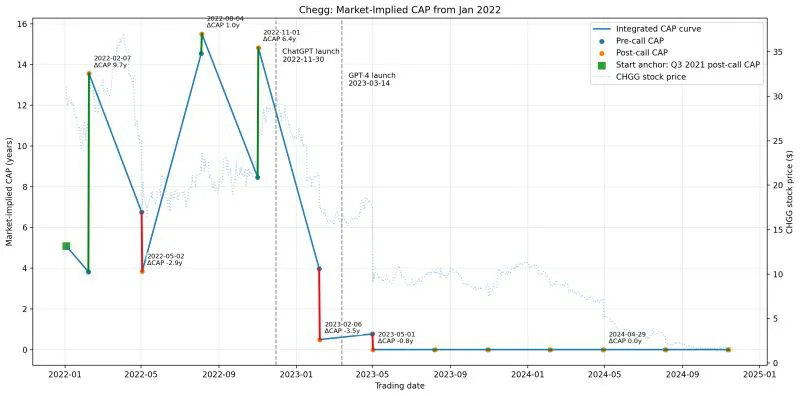
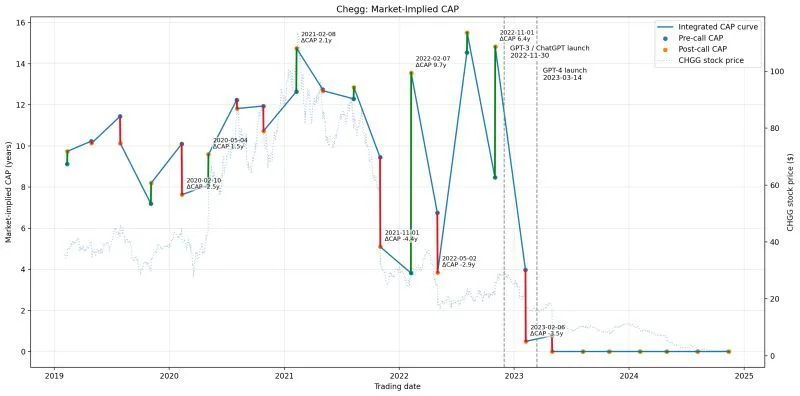
Just for the fun of it, I applied the methodology described in detail in Michael Mauboussin and Dan Callahan, CFA's latest installment in the delightful series of exposés we have come to expect from Mike and team, "Competitive Advantage Period" (CAP), the period of above-cost-of-capital (WACC) returns on incremental investment (ROIIC). This one is a fantastic finance history primer and I wondered to what extent we can still apply it in the era of AI-generated dislocations. The perfect test is Chegg, a company that had a rather positive outlook (recovering from an awful 2021 run) when reporting its financial results on 11/1/2022, less than one month before the chatGPT tremor (11/30/22 launch) and 4 months before the actual earthquake (GPT-4, 3/14/23). The CEO stated: “Our results reflect excellent execution and show the inherent profitability of our model while we continue to invest for future growth." Awesome. The market loved it, the stock shot up 24% on 11/2. Now for CAP: on 2/11, FY22 revenue guidance midpoint of about $763.5M, adjusted EBITDA guidance midpoint ~$230M, or ~30% margin, and 11/2/22 market cap of about $3.26B. Chegg’s Q3 filing showed 125.4M shares outstanding, $69.3M cash, $871.4M short-term investments, and $286.8M long-term investments. Debt principal after the Q3 repurchase was about $500M of 2026 notes and $700M of 2025 notes. Base-case assumptions: fade of 0.13, using Consumer services-education-services-like proxy. Explicit growth 5%, WACC 9.5%, long-term growth ~2.2% using 11/22 expected inflation, normalized tax rate 21%, explicit sales/NOPAT growth 5%, and ROIIC 50%. Under those post-call assumptions, Chegg solves to roughly 15 years of CAP. I went ahead and applied the same approach to every earnings call since January 2022 and, why not, January 2019, comparing pre- and post-call market-implied CAP. We see big swings pre- and post-earnings (well, it’s market-implied!) and the two events: GPT-3 and GPT-4. 📈 Stock price on 11/30/22: ~$29.86, estimated CAP: 16 years. Then on 5/2/23, the CEO stated: "since March, we saw a significant spike in student interest in ChatGPT [GPT-4]. We now believe it's having an impact on our new customer growth." 📉 Stock price post call on 5/2/23: $9.08. Disruption eats CAP for breakfast. Since May 2023, CAP=0. No moat. I have a deep appreciation for the intellectual discipline behind these calculations. But the output is beside the point: predicting the moat is in fact their single most important input.