Complexity Science
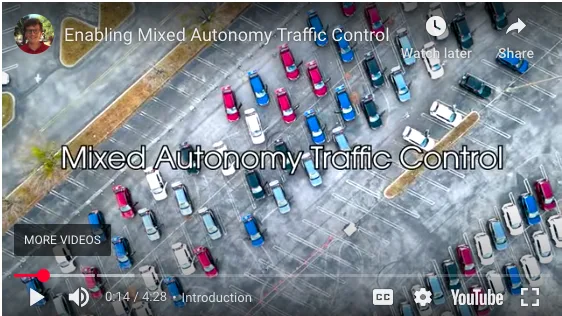
In a stimulating post (link in the comments), @bloomberg beta’s @roy bahat highlighted a fascinating 2017 (yes, 8 years ago!) study from this dense urban center that is @the university of Illinois Urbana-Champaign (why they had to run their experiments on a Tucson, AZ parking lot is puzzling). The study’s leader, @daniel work, moved to @vanderbilt university in Nashville, TN, where traffic is arguably more of a daily occurrence. In a nutshell, the study suggests that ONE self-driving car adapting its speed to the average speed of the set of all cars (which is global information, but let’s skip this issue for simplicity) can regulate traffic, prevent stop-and-go behavior and increase the average speed. Tiny intervention, large effect.
Roy generalizes the results of the study to other domains, a lot of yummy food for thought, I highly recommend. But what struck me about the post, as it would, is the role of “complexity science”, the quest to understand complex systems that is at the core of my postdoctoral alma mater @santa fe institute. I have always loved traffic, not as an experience but as the perfect illustration of the counter-intuitive, emergent phenomena that can happen in complex (adaptive) systems. @Tom vanderbilt’s delightful 2008 book “Traffic. Why we drive the way we do” is filled with illustrations of such phenomena: phantom traffic jams (when you are basically in traffic for no identifiable “reason”), traffic jams moving backward, the effects of variable speed limits (reducing the speed limit may increase the average speed of cars) and many more spooky examples.
The idea of designing small interventions with large effects in complex systems is an old one. From designing emergency exits and egress routes in public spaces to avoid stampedes to inserting robotic chickens in poultry farming to increase movement and/or reduce panic, people have been trying to do just that, often simulating the effects of interventions before proceeding to physical tests. Work’s 2017 experiment with real cars on a fake circular road is a proof-of-concept in the physical world -it is actually very easy to simulate, many have done it with, say, StarLogo (@minerva 2014-2015 students do you remember?). Doing it in the physical world requires reliable self-driving cars. Work’s website shows that things get a lot more complicated in real life, assuming you don’t live on a large, empty parking lot. What’s fascinating is that the approach is still based on the concept of small interventions with large effects, exploiting nonlinear responses in complex systems.
As for the role of AI in all of this, well, of course self-driving cars are AI creatures. But a look at Work’s website shows that his group is now using AI in other ways, including in variable speed limit control. And, being a little bit biased, agent-based simulation combined with AI-based estimation of parameters (froe example from video), is the ideal testbed for interventions.
https://arxiv.org/pdf/1705.01693
https://tomvanderbilt.com/books/traffic/