An article I thought I would easily dismiss but couldn’t
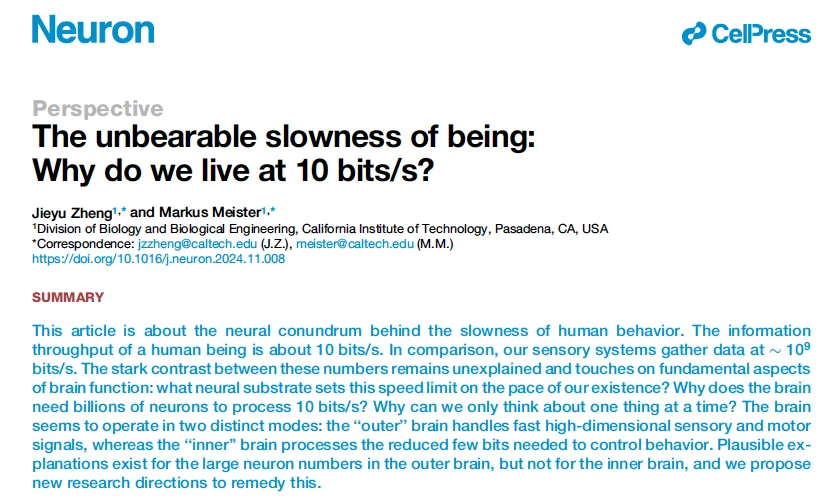
This article that just came out in Neuron (paywall but free preprint here: arxiv.org/abs/2408.10234) but has already attracted a lot of attention, including a piece New York Times (www.nytimes.com/2024/12/26/science/speed-of-th…). I went through the New York Times comments and found an overwhelming majority of negative opinions about the “findings”, some going as far as accusing the reporter of picking random articles from obscure journals. But Neuron, far from being obscure, is one of the top neuroscience journals, and what struck me even more was that none of the commenters took the time to read the article before commenting.
Before reading the article, just the abstract, I have to say that my first impression was similar to the commenters’: the tasks selected for measurement are weird and unusual, there is a lot more that takes place in the brain, brains are not computers, using bits to describe cognitive processes is reductive, 10 bits/s you must be kidding it can’t be true, etc.
But then I read the article, the whole thing. The pair of @Caltech authors, @Jieyu Zheng and @Markus Meister made such a compelling case that, even if you are not fully convinced, it forces you to think about the “disappearing data”: the 8 orders of magnitude difference between input and output flows. The 10 bits/s in the title just means that the measurable output of all that processing by the brain is of the order of 10 bits per second, it can be 5 or 50 or 80 but cannot be much more than an order of magnitude bigger.
One answer to the curious case of the disappearing data is sequential processing with capacity constraints from many parallel sensory channels: IF we accept that we are sequential processors (e.g., we can only have one thought at a time) and that our output channels have strong capacity constraints, then there has to be a reduction in the flow. Put differently, the brain transforms parallel firehoses into in a single dripping faucet, so the flow has to be adjusted. Which begs (at least) two questions: (1) How does this adjustment happen (what is the compression or dimensionality reduction method)? (2) Is the data that doesn’t end up in the dripping faucet discarded or is it used or stored in some other ways?
One area where I disagree strongly with the authors, though, is when they criticize the idea (publicized by @Elon Musk) that we can’t increase the communications bandwidth between brain and computer: they implicitly assume a connection at the level of the dripping faucet but brain-computer interfaces (#BCI), particularly implants, may be able to connect way upstream, picking up signals that never make it to the faucet.
In fact, as early as 15 years ago, I collaborated with BCI pioneers @Don Tucker and @Phan Luu to capture signals prior to the faucet’s bottleneck for image analysis applications (fast serial presentation of 20 images per second). Event-related potentials waveforms N150, N200 and P300, however crude, can pick up recognition signals that may never make it to consciousness or cognitive processing.