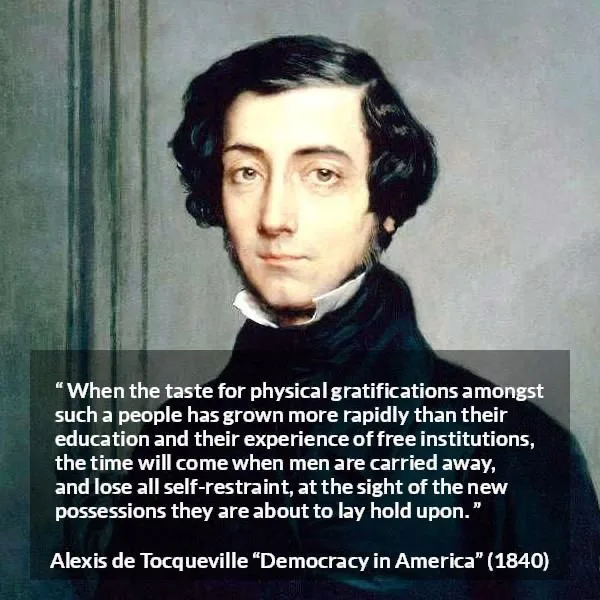
Alexis III
As a final homage to the timeless observations of Alexis de Tocqueville in Democracy in America (1835), there is a lot to learn from his description of the constant pursuit of material (and rapid) gratification, of people who are "restless in the midst of abundance." What he describes in the quote here is the decoupling between the need for long-term goals, long-term thinking and solid foundations from the ubiquitous opportunities for short-term gratification that seem to make more complex intellectual endeavors obsolete. And that was a few years before the Internet.
“The passion for worldly welfare then defeats itself, and, without perceiving it, throws the object of their desires to a greater distance.
There is, indeed, a most dangerous passage in the history of a democratic people. When the taste for physical gratifications amongst such a people has grown more rapidly than their education and their experience of free institutions, the time will come when men are carried away, and lose all self-restraint, at the sight of the new possessions they are about to lay hold upon. In their intense and exclusive anxiety to make a fortune, they lose sight of the close connection which exists between the private fortune of each of them and the prosperity of all. It is not necessary to do violence to such a people in order to strip them of the rights they enjoy; they themselves willingly loosen their hold.”
Picture and quote: lnkd.in/gSYbgrxH