AI in the biotech/pharma R&D productivity equation
As Insilico Medicine has released fascinating R&D benchmarks (lnkd.in/gqFz5gCk), I find it useful to get back to basics to understand the fundamentals.
✨💊 Borrowing from what I consider the gold standard in defining it (2010 Nature Reviews Drug Discovery article by Steven Paul and is then-colleagues at Eli Lilly and Company, “How to improve R&D productivity: the pharmaceutical industry’s grand challenge”, lnkd.in/ge43SAvJ), R&D productivity or performance in pharma and biotech (drug discovery and development) can be decomposed at a high level into 5 interconnected elements:
- Volume of work in progress (WIP, e.g., number of programs)
- Probability of success of each program (Pts)
- Value (V, derived e.g. from an estimate of peak sales)
- Cost (C, cost to “closure”, e.g., failure or launch)
- Cycle time (T, time to “closure”, e.g., failure or launch)
The goal is then to maximize in the aggregate
[WIP*Pts*V]/[C*T]
under the constraints of your available resources (basically limits on WIP and C). It is obviously simplistic and each element needs to be further defined for each program, but it does help identify the levers available to improve performance:
Increase the numerator and/or decrease the denominator.
Most of the denominator, cost and time, happens in later stages of development. If AI can help compress the cost and duration of human studies, that will be a total game changer. In the meantime, AI-driven improvements on the denominator, if real, happen in the earlier stages: exciting but not a 100x or even a 10x value modifier.
The numerator is where AI has the best chance of shining in the short term (say, 24 months, which is short by pharma’s geological timescale). If AI-driven assets can be best- or first-in-class, that increases V, but only if they succeed. If AI can also increase Pts by promoting assets into IND-enabling or clinical studies that have a higher chance of succeeding downstream, then it could be a 10x or even 100x value modifier: it is the compound effect of both Pts and V. Last but not least, WIP is an opportunity too if you can achieve it while increasing C sub-linearly. For example, @insilico’s WIP is astounding, which shows that there is another compounding effect that could propel a couple of the AI-driven drug companies into the stratosphere. The next 24 months will be super exciting to watch.
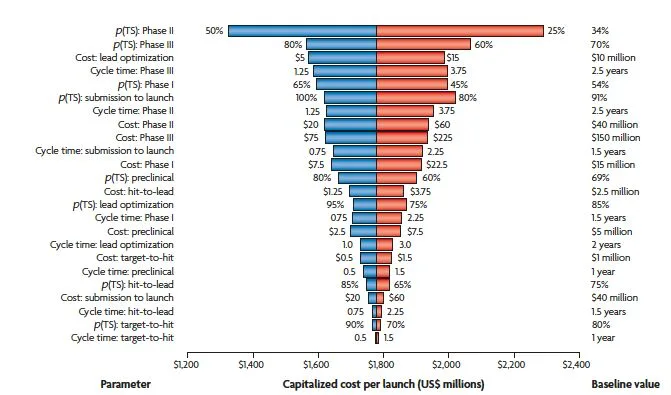
The figure below is from the 2010 article, with 2010 numbers, but everything else remains very similar.
Alex Zhavoronkov, Andrew Dunn, Steven Paul, Stacy Lindborg, Aaron Schacht, Simon Birksø Larsen, Kristen Fortney, John Cumbers, Cyrille Kuhn, Bernard Munos, Claude Bertrand, Dave Ricks, Ashley Magargee, Trevor Mundel, Richard Barker, Mitch Waldrop, Andrii Buvailo, Ph.D.