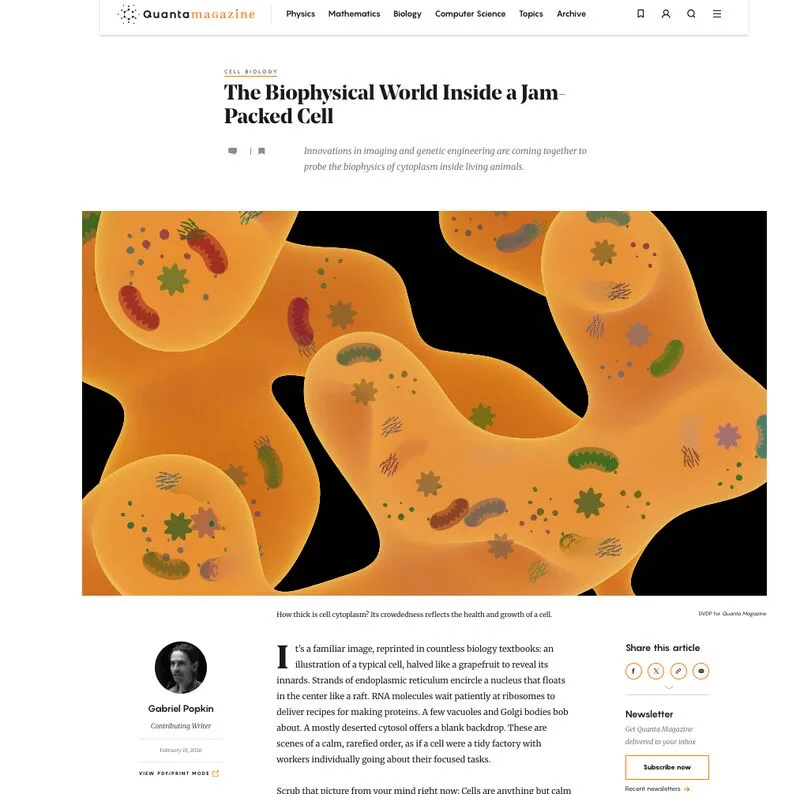
1 billion biochemical reactions occur every second in every cell of our bodies
A great Quanta Magazine article by Gabriel Popkin focuses on how "crowded" and active cells are: "the packing of molecules into tiny spaces is emerging as a fundamental way that cells have evolved to harness physics to bring molecules together for the estimated 1 billion biochemical reactions that occur every second in every cell of our bodies."
Highlighting the work of Liam Holt, G.W. Gant Luxton and Daniel Starr, with a sidebar on Simone Reber, it is a perfect reminder of how complex cells are, how little we really know and, for me, the sheer scale of the "parallel processing" that is happening in every single cell every second. In 2026, we have to accept that science is still attempting to understand the emergent properties of that giga-scale spatio-temporal dance using rudimentary instruments. Each level of description has its own semi-autonomous dynamics and creates feedback loops to lower and higher levels. As a result, I am skeptical of the "virtual cell" kitchen sink approach that tries to model everything. A model has to have a purpose and generate testable predictions. A vast ensemble of less comprehensive models, each describing a subset of mechanisms relevant to a specific goal, seems more promising to me.
For example, I think the density-based perspective pursued by Simone Reber could lead to incredible insights. Statistical physicists will recognize an opportunity to explore possible phase transitions.